
Can Lash Extensions Damage Your Natural Lashes? Causes and Care

Yes, lash extensions can damage my natural lashes when they’re too heavy, poorly applied, or joined together in a way that pulls as lashes grow. But normal shedding isn’t automatically a sign of damage: extensions fall out with the natural lashes they’re attached to, and natural eyelashes renew on a cycle of 60 to 90 days.
It’s understandable to worry when you see lashes shed or notice gaps after a set. The key is whether shedding follows the natural growth cycle or the extensions are putting unnecessary strain on your lashes. This article explains how fit, application, hygiene, and removal affect lash health, what regrowth can look like, and how to care for extensions without disrupting your natural lashes.
Table of Contents
Choosing extensions suited to natural lash thickness and length
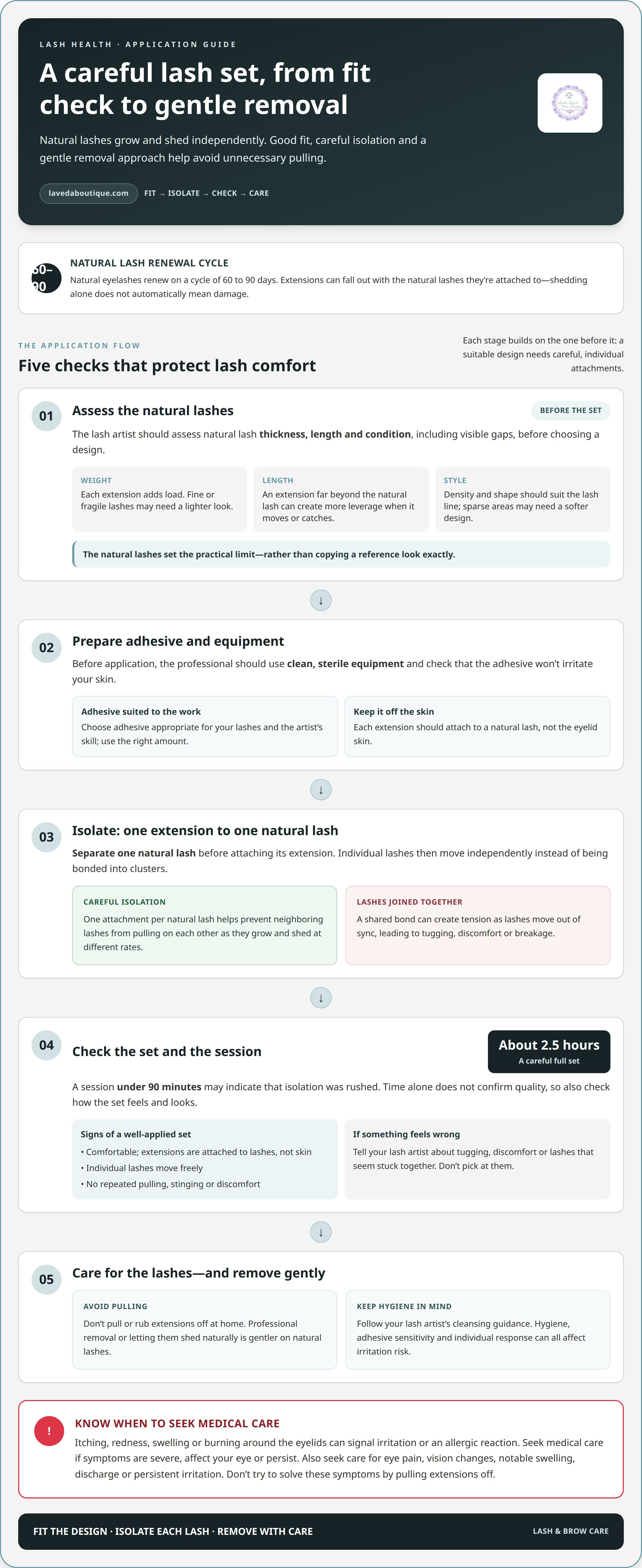
Extension fit matters: length, weight, and style should suit the natural lashes carrying them. A lash artist assesses their thickness and condition before choosing a design. If your lashes look unusually thin or have visible gaps, discuss those areas before application. They may need a lighter, more restrained look than the rest of the lash line.
Weight is a key consideration because each extension adds load to a natural lash. A longer or fuller design may look appealing in a reference photo, but the photo doesn’t show whether your lashes can support it. The artist should adapt the extensions to your natural lash strength rather than copy a requested style exactly. If a lash looks fine or fragile, a less dramatic extension can avoid unnecessary strain.
Length also affects fit. An extension that extends far beyond the natural lash can create more leverage when it moves or catches. The artist should consider each lash’s length and condition, then choose an extension that looks balanced rather than oversized. For example, if some lashes are shorter or finer than others, a uniform, long set may not suit the entire eye. A customized design can account for those differences.
Style should follow the same assessment. A dense volume look and a more understated look place different demands on the natural lash line. Ask whether your preferred shape is realistic for your lashes, especially if you have sparse sections. The right choice may be to soften the style or adjust its density, not force every lash into the same dramatic effect. Your desired result matters, but your natural lashes set the practical limit.
Lash lifts and strip lashes aren’t automatically safer than extensions for everyone. A lift changes the appearance of natural lashes, while strip lashes sit along the lash line. Application, removal, and personal sensitivity all matter. Choose based on your needs and how each option is applied and removed, rather than assuming one method has no risk.
For irritation or injury, stop wearing the extensions and seek medical care if you have eye pain, vision changes, notable swelling, discharge, or irritation that persists. These symptoms need attention from a healthcare professional, not an attempt to solve the problem by pulling extensions off.
During a fitting, the artist can assess lash thickness, length, and visible gaps, then tailor the extension style accordingly. This helps determine whether extensions suit your natural lashes and which design is a better match.
Professional application and hygiene precautions
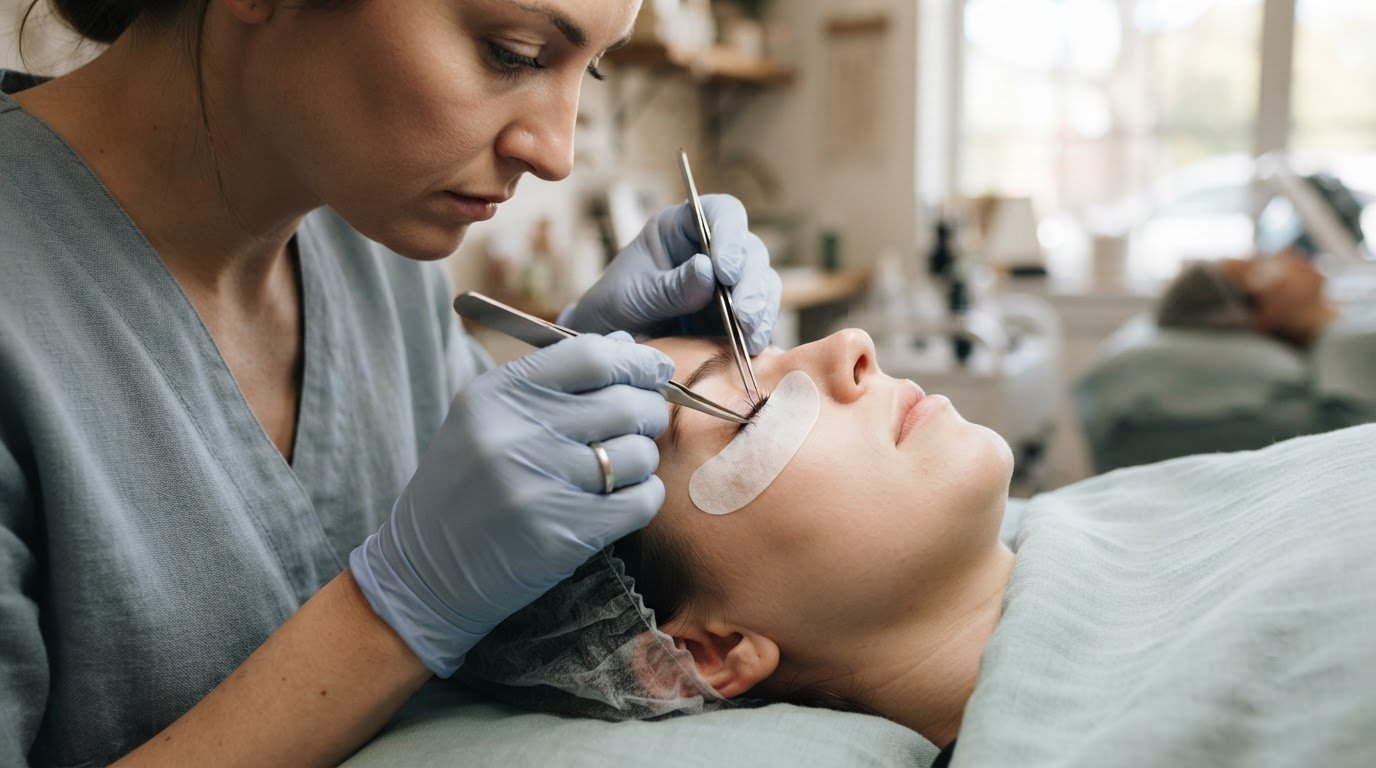
Safe application depends on careful isolation, appropriate adhesive, and clean equipment. Each extension should attach to one natural lash, not the skin.
How Poor Application Can Cause Damage
Poor application can strain natural lashes if extensions attach to the skin or several lashes stick together. As lashes grow at different rates, joined lashes can pull against one another. Adhesive on the skin can irritate it and affect newly growing lashes. Discomfort or tugging can signal that the application needs attention.
Lash Isolation and Application
Lash isolation means separating one natural lash before attaching an extension to it. This prevents neighboring lashes from bonding together and moving as a group. A professional should select adhesive suited to your lashes and their skill, use the right amount, and keep it off your skin. Before application, they should check that the adhesive won’t irritate your skin and use sterile equipment.
Safe application and removal both require care: extensions are attached individually to natural lashes, then removed professionally or left to shed naturally. Don’t pull or rub them off at home. A careful full set takes about 2.5 hours; a session under 90 minutes may indicate that isolation was rushed.
Signs of a Safely Applied Set
A well-applied set feels comfortable, with extensions attached to lashes rather than skin. Individual lashes should move freely instead of being bonded into clusters. Watch for repeated pulling, stinging, or discomfort after application, and tell your lash artist if something feels or looks wrong. Lashes that seem stuck together may need professional attention, not picking.
Possible signs of irritation or an allergic reaction include itching, redness, swelling, or burning around the eyelids. If symptoms are severe, affect your eye, or persist, seek medical care rather than attempting removal yourself.
Infection and Allergy Frequency
Infection and allergic reactions are possible. Their likelihood depends on factors such as hygiene, adhesive sensitivity, and individual response. Clean equipment and a careful adhesive check help address avoidable risks, but can’t rule out every reaction. If irritation or an unusual change appears after application, stop rubbing the area and seek medical advice for concerning or persistent symptoms.
If you’re considering a set, professional lash extensions begin with an application tailored to your natural lashes and careful attention to isolation.
Damage caused by lashes or extensions glued together
When two or more natural lashes attach to one extension or fan, they become linked instead of moving independently. This matters because natural lashes grow and shed at different rates. One attached lash, for example, may be ready to shed while another remains firmly rooted. The extension can pull on both, creating tension that a single, properly separated attachment would avoid.
That tugging can cause discomfort and may damage or break lashes. A lash that grows faster than its neighbor can pull against the shared extension, while the slower-growing lash resists. As the lashes move out of sync, the bond creates pressure at their roots. Repeated strain can affect both attached lashes, not just the extension connecting them.
Shedding can make the problem more pronounced. If one natural lash releases while still joined to another, its movement can pull on the remaining attached lash. That lash may then break or be pulled out with the shed one. A small clump can therefore affect several natural lashes, especially if it catches during brushing or ordinary movement.
Notice whether an extension feels painful, irritating, or unusually tight. Look for lashes that appear stuck together and don’t move independently. These signs don’t prove the cause, but they give you a clear reason to stop handling the area and tell your lash artist what you’re experiencing. Don’t test a bond by pulling individual lashes. Picking at a painful or irritating cluster can pull out natural lashes.
Keep your hands away from clumped extensions. Picking, pulling, and aggressive rubbing add force to lashes already connected together. Tugging at an extension to separate two lashes, for instance, can pull both natural lashes at once. If the cluster feels uncomfortable, don’t try to loosen it with your fingers or tools. Tell your lash artist if the issue repeatedly feels or looks wrong.
Removal matters as much as noticing the problem. Pulling or rubbing extensions off at home can remove natural lashes along with them. Have extensions removed professionally, or allow them to shed naturally. A lash artist can assess how the previous set retained, check your natural lash condition, and identify where shedding occurred during a fill. That assessment helps distinguish routine shedding from strain caused by lashes glued together.
After the issue is addressed, avoid repeating the same pressure on your lash line. Properly separated attachments let each natural lash move and shed on its own. If a future set develops painful clusters or repeated sticking, report the specific area promptly rather than waiting for more lashes to pull or break.
Natural lash regrowth after damage
Natural lashes are expected to grow back after damage from an incorrectly performed extension application. Recovery isn’t immediate, so a sparse area can remain visible as replacement lashes emerge. Lashes naturally differ in length and growth stage, which can make one section look uneven beside another. For example, a gap near the outer corner may fill in gradually rather than becoming uniform at once.
Natural eyelashes damaged by a poor application typically recover fully within a couple of months. That describes a typical recovery, not a precise schedule for every lash. The affected area, extent of damage, and continued strain can influence what you notice. A short new lash beside longer lashes may show regrowth has begun, even before the lash line looks full again.
During recovery, avoid pulling at extensions or tugging on short lashes. A lash that looks loose may be shedding naturally, while a forced pull can add stress to the surrounding lashes. For instance, don’t use tweezers to remove a small cluster or try to separate stuck lashes yourself. Gentle handling gives growing lashes room to emerge without extra pulling from your fingers.
Give the lash line time to recover before adding more weight or tension. A fresh set placed over fragile, uneven lashes can make it harder to distinguish regrowth from continued breakage. If an area remains sparse, describe when you first noticed it and whether you felt discomfort. Those details help a lash professional assess its visible condition before considering another application.
Track changes with simple observations rather than daily comparisons. Note whether a bare patch is becoming less noticeable, whether short lashes appear, and whether surrounding lashes look affected. For example, compare the same area under similar lighting after a reasonable interval instead of relying on a single close-up. These observations can clarify how the lash line is changing as it recovers.
If your lash line feels comfortable and new lashes appear, continued gentle care supports recovery. Avoid rubbing, picking, or forcibly removing extensions, since those actions can pull on natural lashes. If discomfort or visible damage continues, pause cosmetic handling and seek appropriate professional advice. Regrowth after a poor application is expected, but repeated pulling can disrupt recovery.
Once your lashes have recovered, any future extension choice should account for their current condition, not just their previous appearance. A shorter or lighter design may be more suitable if the affected area still looks delicate. The key is to allow natural recovery rather than add another application before the lashes appear ready to support it.
How lash extensions relate to the natural lash growth cycle
Natural eyelashes renew on a growth cycle of 60 to 90 days. Like hair on the head, lashes don’t all grow and shed in unison. Each lash follows its own timing, so the lash line is continually changing. One extension may remain in place while a nearby extension has already shed with its natural lash. That variation can make gradual shedding look uneven, even when it reflects the normal cycle.
An extension is attached to a natural lash, so it falls out when that lash sheds. Seeing an extension come away with a natural lash doesn’t automatically mean the lash was damaged. Extensions may release at different times across the same eye because their attached lashes are at different stages. The key distinction is whether a lash sheds as part of its cycle or shows signs of strain from the extension.
Weight connects the growth cycle to potential damage. An extension that’s too heavy for its natural lash can add strain as that lash grows and moves. This may cause premature lash loss and disrupt the natural growth cycle. A dramatic style that puts more load on delicate lashes can work against the timing and condition of the lashes beneath it. Appropriate fit matters throughout wear, not just on application day.
Think of a single extension as moving with its attached lash. As the natural lash grows, the extension moves away from the lash line; when the natural lash sheds, the extension comes away too. That movement is expected. By contrast, tugging, breakage, or lashes joined together can point to stress rather than ordinary renewal. A fill gives the artist an opportunity to assess retention, natural lash condition, and where shedding occurred.
Use the 60 to 90 day cycle as context, not a promise that every lash line will look full on a particular day. Different lashes renew at different times, so a temporary gap may reflect staggered shedding. Observe whether lashes appear to be growing back and whether discomfort or repeated breakage continues. These details help separate normal turnover from problems related to excessive weight or application strain.
For a cycle-conscious set, choose an extension weight suited to your natural lashes and note any repeated shedding or discomfort during wear. A professional assessment can consider how the previous set retained and how your natural lashes look now. Book a lash extension appointment to discuss an extension fit that respects your natural lash cycle.
Laveda Lash & Brow Boutique: Lash Extensions
Laveda Lash & Brow Boutique offers Lash Extensions for a tailored lash look. Turn to the service when you’re ready to discuss how extensions may suit your natural lash thickness, length, and current condition. Sharing your preferred style and any concerns, such as visible gaps or past discomfort, gives the discussion a practical starting point.
If you’d prefer to enhance your natural lashes without extensions, a Lash Lift is another option. The right choice depends on the look you want and the condition of your lashes. Discuss your goals before deciding which service feels appropriate.
For a personal conversation about Lash Extensions or a Lash Lift, contact Laveda Lash & Brow Boutique.
Choose Your Next Lash Look With Confidence
If you’re still weighing whether lash extensions can damage your natural lashes, base your next choice on your priorities and current lash condition. A striking result should still feel comfortable and suit the lashes you have now. You don’t need maximum length or fullness to create a polished look.
Before deciding, consider the finish you want and how much daily upkeep feels right for you. Share those preferences, along with any past discomfort, when discussing your options. That gives the conversation a practical starting point and helps align the look with what feels manageable.
Choose thoughtfully, then pay attention to how your lashes feel as you wear the style. If you’re ready to discuss your next step, contact Laveda Lash & Brow Boutique. A considered choice can help you feel confident in your lash look.
Frequently Asked Questions
Quick Answer: Do Lash Extensions Damage Your Natural Lashes?
They can, especially if an extension is too heavy or application creates pulling. Extensions don’t automatically damage lashes: normal shedding continues while you wear them. If you notice repeated discomfort, breakage, or a new sparse patch, avoid pulling at the area. The pattern and timing of shedding can help distinguish routine turnover from strain that needs attention.
Are Some Lash Styles More Damaging Than Others?
Styles that add more weight can place greater demands on natural lashes, particularly if they’re fine or sparse. A dense, dramatic look may not suit every lash line. A lighter design, for example, may be more appropriate where lashes are delicate or uneven. The deciding factor is whether your natural lashes can comfortably support the requested length and fullness.
Do Lash Extensions Ruin Your Eyelashes?
No, lash extensions don’t inevitably ruin natural lashes. Problems are more likely when application or wear puts repeated strain on them, such as through excessive weight, pulling, or extensions joined together. If your lashes look thinner after removal, consider whether they were pulled or repeatedly irritated. Avoid another application until the lash line’s condition has been assessed and discomfort has settled.
Does Getting Fills Over and Over Damage Your Lashes?
Fills don’t automatically damage lashes, but each appointment should account for how your natural lashes look at the time. A previous set may retain unevenly, or one area may show more shedding. Share those changes before continuing with the same design. If lashes appear strained or an area is thinning, discuss adjusting the look or pausing extensions rather than automatically repeating the previous set.
How Can You Tell Normal Shedding From a Problem?
Normal shedding tends to happen gradually, with extensions coming away alongside their attached natural lashes. Repeated tugging, breakage, painful clusters, or a sudden bare area are more concerning signs. Several lashes stuck together, for example, may pull against one another as they move. Don’t test the bond by pulling; note what you see and describe it to your lash artist.
What About Lash Adhesive?
Adhesive matters because skin contact can irritate the eyelid and affect newly growing lashes. A professional should use an amount suited to the application and choose adhesive appropriate to your lashes and their skill. Before application, they should check that it won’t irritate your skin. If you notice itching, redness, or swelling afterward, stop rubbing and seek medical advice if symptoms persist or worsen.
What Should You Ask Your Lash Artist?
Ask how the proposed length, weight, and style suit your natural lashes. You can also ask whether each extension will attach to an individual lash, what cleansing guidance to follow, and how removal should be handled. If you’ve experienced irritation, sparse patches, or discomfort before, describe when it happened. Specific details help the artist assess your lash condition and adapt the plan.
Can eyelash extensions permanently damage natural lashes?
Permanent damage isn’t the expected outcome after a poorly performed application; natural lashes are expected to grow back. Recovery can vary, and repeated pulling or strain may complicate it. If a sparse area remains or your lash line continues to feel uncomfortable, don’t assume it’s routine shedding. Avoid further pulling and seek appropriate professional advice about the change.


Comments