
DC Permanent Makeup Artist Certification Lookup and License Rules
A permanent makeup certification isn't the same as a license in Washington, DC. Body artist applicants, including micropigmentation specialists, must provide a business letter verifying 500 hours of training under a licensed artist. A permanent makeup artist certification lookup in DC can help clarify a practitioner’s credentials, but it shouldn’t be treated as proof of every local requirement.
It’s reasonable to want a clear answer before choosing an artist or starting training. The requirements can involve more than a certificate: the practitioner’s license, health oversight, registration, and establishment permits may all matter.
This guide explains what DC requires, how certification differs from licensure, and what to look for when reviewing training and credentials. It also explains how local health oversight and establishment permits fit in, so you can see what a permanent makeup artist certification lookup in DC can and cannot confirm.
Table of Contents
Do I Have to Get a License to Be a Permanent Makeup Artist?
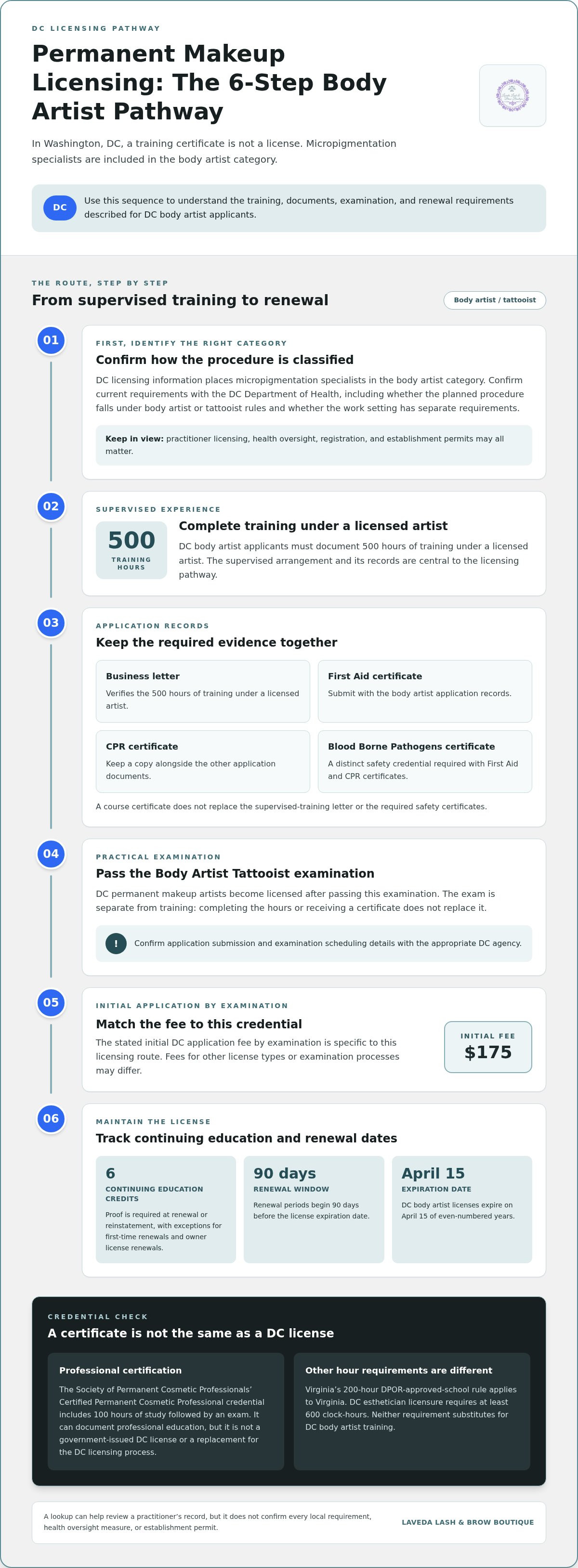
DC licensing information places micropigmentation specialists in the body artist category, with 500 hours of supervised training required for applicants. Initial application by examination is $175; renewal requires 6 continuing education credits, except for first-time renewals and owner license renewals.
Approved Training and Course Hours
For DC body artist applicants, training means completing 500 hours under a licensed artist, verified by a business letter. This requirement makes the training arrangement and its documentation central to the licensing pathway. Keep the letter and training records together, and confirm that they describe supervised body art education.
Virginia has a separate rule: applicants must complete a 200-hour program at a DPOR-approved school to work there as permanent makeup artists. Those course hours apply to Virginia, not DC. An esthetician program is also a distinct credential route: DC esthetician licensure requires at least 600 clock-hours. Don’t treat either program as a substitute for DC body artist training.
Practical Examination Requirements
A practical examination assesses the hands-on skills required for a license. DC permanent makeup artists become licensed after passing the Body Artist Tattooist examination. The District requires practical examinations for listed license types, with exceptions for braiders, master estheticians, managers, and owners.
Separate professional certification is not a government license. The Society of Permanent Cosmetic Professionals’ Certified Permanent Cosmetic Professional credential includes 100 hours of study followed by an exam. Treat that as an additional professional certification, not a replacement for the DC licensing examination or application process.
Confirming Local Requirements
To confirm the right credential, identify which category covers the specific procedure and workplace. DC’s Board of Barber and Cosmetology regulates body artists, including micropigmentation specialists. At the same time, DC guidance on microblading and permanent makeup can differ on district-level regulation. The practical distinction is how the service is classified.
Before training or practicing, confirm current requirements with the DC Department of Health. Ask whether the planned procedure falls under body artist or tattooist rules and whether the work setting has separate requirements. This helps distinguish a training certificate from an esthetician credential or a body artist license.
Fees and Renewal Requirements
The initial DC application fee by examination is $175. At renewal or reinstatement, body artist licensees must submit proof of 6 continuing education credits, except for first-time renewals and owner license renewals. Renewal periods begin 90 days before the license expiration date.
DC body artist licenses expire on April 15 of even-numbered years. Track that date alongside the renewal window and education records. Fees for other license types or examination processes may follow different schedules, so match each amount to the specific credential rather than assuming every beauty license has the same cost.
Training hours and exams for cosmetic tattoo artists
DC body artist applications combine supervised experience, safety certificates, and an examination. Organize each record by requirement: completing a course alone does not establish that you hold a license.
Training records and application documents
DC body artist applicants need a business letter verifying 500 hours of training under a licensed artist. The letter should document the supervised training that supports the application. Applicants must also submit First Aid, CPR, and Blood Borne Pathogens certificates. Keep copies of these certificates with training records, so the application documents show distinct requirements clearly.
Experience gained under supervision is not the same as independent practice. The licensed artist’s letter documents the training arrangement and hours. A course certificate may show education, but it does not replace that letter or the required safety certificates.
Course schedules and training pathways
DC’s 500-hour training requirement does not set a course calendar or weekly schedule. The supervised arrangement determines how those hours are completed and documented. Record completed training as it occurs, and retain the instructor’s business letter for the application.
Don’t apply Virginia’s course rule to DC. Virginia requires a 200-hour course at a DPOR-approved school for permanent makeup applicants. DPOR is Virginia’s licensing agency, so those approved-school hours aren’t a DC submission requirement. In DC, focus on the body artist requirements and supervised training documentation.
Exams and bloodborne pathogens
DC permanent makeup artists become licensed after passing the Body Artist Tattooist examination. Applicants should confirm how to submit applications and schedule examinations. The examination is separate from training: completing the required hours or receiving a certificate does not replace it.
Bloodborne pathogens training is a distinct safety credential. OSHA requires this training for permanent makeup artists regardless of where they live. DC applicants must submit a Blood Borne Pathogens certificate alongside First Aid and CPR certificates. Keep all three records available for the application.
Professional certification versus a license
Professional certification can add evidence of education, but it isn’t a DC license. The Society of Permanent Cosmetic Professionals’ Certified Permanent Cosmetic Professional credential involves 100 hours of study followed by an exam. The American Academy of Micropigmentation certification involves 100+ hours of core training, a nationally recognized written and practical exam, and updated Bloodborne Pathogens Certification.
These credentials document professional training and assessment. For a DC license, the relevant pathway is the body artist application, its required records, and the Body Artist Tattooist examination. When reviewing qualifications, keep certification documents separate from license records.
State and local health department oversight
Health oversight and professional licensing answer different questions. In Washington, DC, the Board of Barber and Cosmetology regulates body artists, including micropigmentation specialists. The DC Department of Health is also an important local reference for health requirements. Treat a practitioner credential search and health oversight as related but distinct parts of your review.
Microblading and permanent makeup involve pigment placed in the skin, so the service’s classification matters. Available DC guidance describes district-level regulation differently across sources. The practical takeaway is to identify how the specific procedure is classified, then distinguish the practitioner’s license from applicable health requirements.
Across the states, microblading oversight generally follows several approaches: body-art or tattoo registration, cosmetology or esthetician licensing, a dedicated permanent makeup license, or minimal state regulation. That variation explains why a credential from another state may not answer what applies in Washington, DC. The jurisdiction and service category determine the relevant oversight route.
Other jurisdictions illustrate how much requirements can vary. California requires body-art practitioners to register with their county and pass a bloodborne pathogens exam under the Safe Body Art Act. In New York City, tattooing requires a tattoo license and the DOHMH infection-control course, while requirements vary across other counties.
Louisiana provides another example: its Department of Health regulates commercial body art, and facilities and operators must receive permits. Individual practitioners must also register with the state. This shows why health department oversight can extend beyond an individual professional credential to the facility and its operators.
For Washington, DC, keep the agency roles clear. The Board of Barber and Cosmetology regulates body artists, while the DC Department of Health is the local reference for health-related requirements. A training certificate, professional certification, license record, and health compliance record each answer a different question.
Use the procedure and work setting to organize your review. For example, distinguish microblading from a conventional brow service, then determine whether the work falls under body-art rules. Consider the practitioner and premises separately. This prevents a credential lookup from being mistaken for a complete health or facility review.
Before training or practicing in Washington, DC, confirm current local requirements with the DC Department of Health. This is especially relevant when a service’s classification is unclear or a practitioner trained elsewhere plans to work in the District. Compare the answer with the licensing record rather than treating one document as proof of every requirement.
DC Department of Health verification
Before choosing an artist, review the DC license record, training evidence, and relevant health oversight. For complaints or disciplinary actions, distinguish an allegation from an official finding, and ask the DC Department of Health how to access agency-held records.
The District’s credential search and a formal license verification letter serve different purposes. A lookup can help identify a record, while a letter provides official license certification or verification.
Verifying an Artist with DC Health
DC Health verification means confirming that an artist’s credential and relevant body-art oversight match the service offered. This matters because a national training certificate or special certification does not establish a DC license.
Washington, DC charges $30 for a letter of license certification or verification. A licensee requesting this letter must have a free Access DC account. If a licensee doesn’t know their license number during renewal or reinstatement, they can enter their name using the License Lookup option.
When reviewing an artist, compare the name on the record with the person performing the procedure. A mismatch may result from spelling, a name change, or searching under a business name. Keep the practitioner’s exact name and credential type in view, and distinguish the license record from training documents.
Reviewing Complaints and Disciplinary Actions
A complaint review separates reported concerns from disciplinary actions formally recorded by an authority. This distinction matters because a complaint alone does not establish a violation or official finding.
Start with the DC license lookup to identify the practitioner’s credential record. For complaints or disciplinary actions, ask the DC Department of Health whether an official disposition exists and how to access agency-held records. Use the artist’s name and license details consistently in your inquiry.
Before booking, review the record alongside training evidence and the procedure being offered. A body art credential, an esthetician license, and a national certification describe different qualifications. For example, a permanent makeup course certificate can document education, but it does not replace a DC license record.
Use the right document for the question. A license lookup helps identify a credential record; a $30 certification letter provides formal verification. Neither document, by itself, explains every health requirement or resolves an unverified complaint. Ask the DC Department of Health about its own records when the concern involves an official complaint or disciplinary outcome.
This distinction supports a more precise review: establish who holds the credential, identify what the record verifies, and separate that result from concerns about the practitioner’s career or conduct. In the District, treat licensing and health oversight as related checks, not interchangeable proof.
Establishment permits and practitioner registration
In DC, practitioner credentials and workplace authorization are separate parts of a review. The Department of Consumer and Regulatory Affairs is identified as the agency responsible for licensing permanent makeup artists. The District’s Board of Barber and Cosmetology regulates body artists, including micropigmentation specialists. Check which credential applies to the procedure, then consider the establishment where it takes place.
DC permanent makeup artists may work in salons and spas with licensed tattoo facilities or in licensed tattoo parlors. This makes the facility’s status relevant alongside the individual artist’s license. A beauty business name alone does not show whether its tattoo facility is licensed. Match the practitioner to the actual service location, not only the salon’s general registration.
Keep the two records distinct. A practitioner license concerns the person authorized to perform body art; an establishment permit or facility authorization concerns the premises. DC requirements identify licensed tattoo facilities and licensed tattoo parlors as work settings. Use this distinction when reviewing a studio, especially if a salon offers several services under one roof.
Applicants already licensed in another state can apply for a DC license by endorsement with an exam waiver. Endorsement concerns the practitioner’s credential, not the facility, and does not remove the need to identify the appropriate work setting. For a consumer, an out-of-state license or academy certificate should therefore be considered separately from the DC license and venue status.
The technician licensing fee in DC is $120. Body artist licenses expire on April 15 of even-numbered years. At renewal or reinstatement, licensees must submit proof of 6 continuing education credits, except first-time renewals and owner license renewals. These details help distinguish an active credential from a course completion document or an older license record.
For a practical review, note the artist’s legal name, credential type, and workplace. Compare the credential record with the procedure and the establishment’s stated setting. If the artist works in a salon, focus on whether the relevant tattoo facility is licensed. If the artist works in a tattoo parlor, distinguish the establishment’s status from the practitioner’s individual license.
These checks clarify whether practitioner registration, license status, and establishment authorization refer to the same person and place. Keep each record tied to its purpose. To explore professional beauty services, view beauty services.
Laveda Lash & Brow Boutique: Lash Extensions
Laveda Lash & Brow Boutique offers Lash Extensions for clients seeking a defined lash look rather than permanent makeup. Lash Extensions and Brow Lamination are beauty services, not substitutes for micropigmentation credentials or license checks. Choose them when you want to focus on lashes or brow shaping instead of booking permanent makeup.
If you’re comparing options, keep the distinction clear: permanent makeup involves separate training and licensing considerations, while these services address a different beauty goal. Laveda’s Lash Extensions provide a lash-focused option, and Brow Lamination focuses on brows.
Visit Laveda Lash & Brow Boutique to explore the services and decide what suits your beauty goals.
Choose Your Next Beauty Step with Confidence
Let your next decision reflect the look you want, not just the credential you searched. A permanent makeup artist certification lookup in DC can help organize your research, while your service choice should match your personal goals. Keep those decisions separate: verify qualifications for permanent makeup, then choose another beauty service if that better suits your plans.
For a non-permanent enhancement, consider Lash Extensions or a Lash Lift. Laveda Lash & Brow Boutique also offers Mani Pedi services, so your next visit can focus on another part of your beauty routine. These services are distinct from permanent makeup and do not replace the checks required for cosmetic tattooing.
When you’re ready to explore a beauty appointment, contact Laveda Lash & Brow Boutique. Take the next step with a clear sense of the service you want and the standards that matter to you.
Frequently Asked Questions
How do I find my state's exact microblading requirements?
Start with the licensing board and health department for the place where the procedure will happen. Microblading can fall under body-art, tattoo, cosmetology, esthetician, or dedicated permanent makeup rules. For example, Virginia requires a 200-hour course from a DPOR-approved school, while DC’s body artist pathway uses different training and examination requirements. Confirm the procedure’s classification and the workplace rules for that jurisdiction.
Looking for a Certified PMU Artist Near You?
In Washington, DC or Arlington, VA, distinguish voluntary certification from a government license before deciding whether a credential meets your needs. A certificate can show professional education, but it does not establish DC licensure. Laveda Lash & Brow Boutique offers Microblading, a brow service; that offering alone does not claim PMU certification. Keep the service you want separate from the credential you’re evaluating.
Does Washington, DC require permanent makeup artists to be certified or licensed?
DC’s body artist licensing pathway covers micropigmentation specialists, while professional PMU certification is voluntary. Applicants must document the required supervised training and pass the relevant body artist examination. Certification may demonstrate additional study, but it does not replace a DC license. A course completion certificate and an active practitioner license, for example, answer different questions about education and authorization.
How can I verify a permanent makeup artist's certification or license in Washington, DC?
Use the DC license lookup to search the practitioner’s name and compare the result with the name providing the service. For a permanent makeup artist certification lookup in DC, keep in mind that the search concerns a license record, not every private training certificate. A licensee seeking formal license verification can request a letter; DC charges $30, and the licensee needs a free Access DC account.
Which DC agency regulates permanent makeup and tattoo artists?
The District of Columbia Board of Barber and Cosmetology regulates body artists, including micropigmentation specialists. The DC Department of Health is the local reference for health-related requirements. These roles are related but distinct: the board’s oversight concerns the body artist credential, while health questions concern local health oversight. Identify which question you’re asking before treating one agency record as proof of the other.
What training and certifications are required to perform permanent makeup in DC?
DC body artist applicants need documentation of supervised training, First Aid, CPR, and Blood Borne Pathogens certificates, plus the Body Artist Tattooist examination. Bloodborne-pathogen training is an important part of safe practice for permanent makeup artists. Professional credentials, such as Society of Permanent Cosmetic Professionals certification, involve separate study and examination. Treat those credentials as additional professional education, not substitutes for DC licensing requirements.
What is the difference between a permanent makeup certification and a DC license or permit?
A permanent makeup certification documents professional study or assessment; a DC license is the practitioner’s credential. An establishment permit or facility authorization concerns where body art is performed. For example, an artist’s course certificate does not establish that a workplace is a licensed tattoo facility. Keep the practitioner’s qualifications and the establishment’s authorization separate when reviewing documents.
What health, safety, and bloodborne-pathogen rules apply to permanent makeup artists in DC?
DC body artist applicants must submit First Aid, CPR, and Blood Borne Pathogens certificates, and OSHA requires bloodborne pathogens training for permanent makeup artists. Health oversight is separate from professional certification. In a practical review, distinguish the artist’s safety training documents from health requirements that apply to the work setting. The DC Department of Health is the local reference for health oversight questions.