
Dermaplaning in Arlington, VA: Safety, Results and Downtime

Dermaplaning removes dead skin cells and fine facial hair with a sterile surgical scalpel, leaving the skin’s surface smoother. It’s generally considered safe for most skin types, but active acne, irritation, and some skin conditions can make it unsuitable. If you’re asking what dermaplaning is and whether it’s safe in Arlington, VA, the answer depends partly on your skin’s current condition.
It’s reasonable to want clearer skin without a long recovery or unexpected irritation. Redness or sensitivity typically fades within a few hours, and results often last about 3 or 4 weeks. This guide explains how dermaplaning works, who may benefit, who should approach it cautiously, and what to expect from the treatment, including possible risks, downtime, and aftercare. You’ll also learn how it can affect the appearance of dullness and shallow acne scars, and why facial hair doesn’t grow back thicker or darker.
Table of Contents
Who can perform a dermaplaning skin care treatment?
Choose a licensed skin care professional or medical aesthetician with dermaplaning-specific training. Because the treatment uses a sterile surgical scalpel, technique and skin assessment matter. A trained professional can review your skin, explain likely benefits, and identify reasons to postpone. Dermaplaning is generally considered safe for most skin types, including sensitive skin, but active irritation and certain conditions call for extra care.
Before booking, discuss active breakouts, irritation, skin conditions, and recent treatments. Active acne can make dermaplaning a poor fit because scraping may irritate skin and spread bacteria. Cold sores, eczema, psoriasis, contact dermatitis, radiation burns, and certain skin growths also warrant a conversation with a healthcare provider before treatment. Rosacea and other sensitive or reactive skin concerns should be part of this assessment, too.
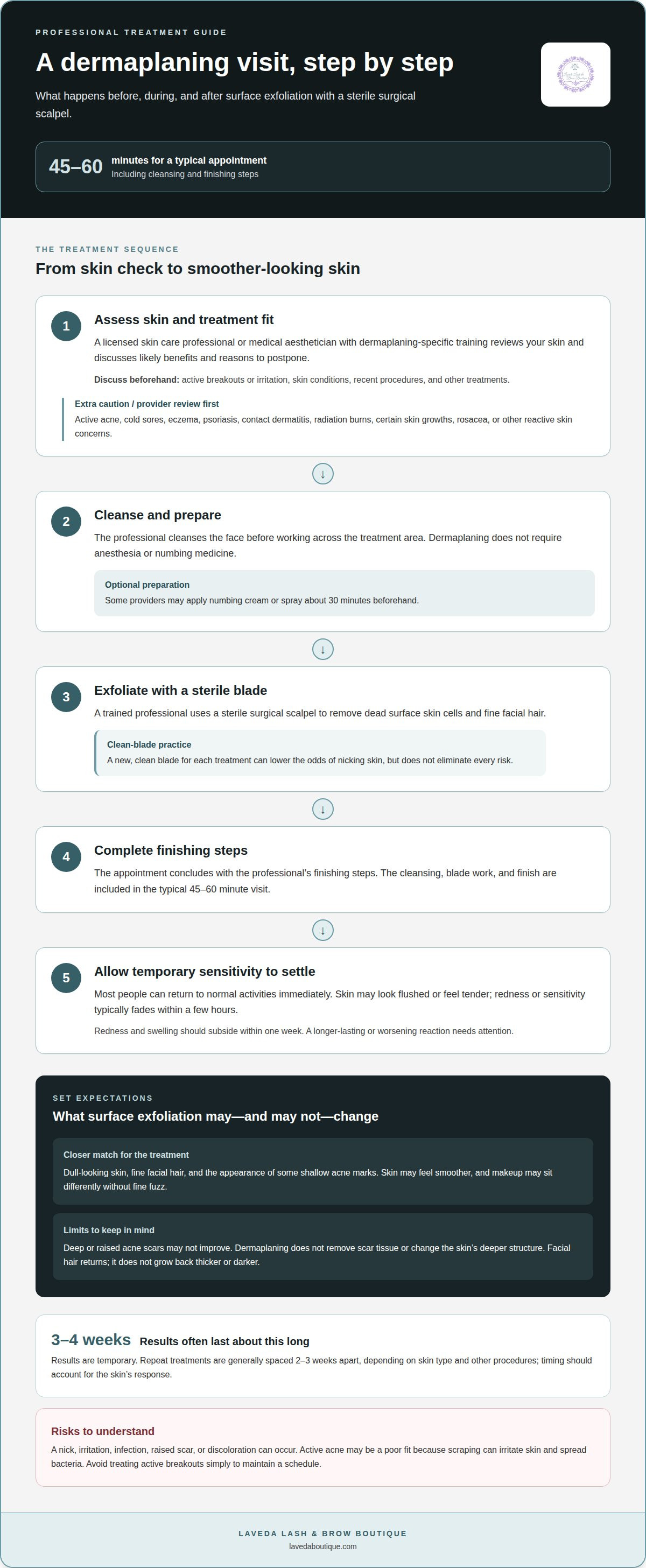
During a typical session, the professional cleanses the face and uses a sterile blade to remove surface skin cells and fine facial hair. A new, clean blade for each treatment can lower the odds of nicking skin. Appointments commonly take 45-60 minutes, including cleansing and finishing steps. Dermaplaning requires no anesthesia or numbing medicine, though some providers may apply numbing cream or spray about 30 minutes beforehand.
Professional dermaplaning uses a sterile surgical scalpel and is performed by someone with specific training, unlike at-home dermaplaning. Home tools and technique differ, and they don’t provide the same professional assessment or procedure. A nick, irritation, infection, raised scar, or discoloration can occur with treatment.
Tell the professional about your skin history before the blade touches your face. Mention a current breakout, recent procedure, or eczema flare, for example. That information helps determine whether to proceed, postpone, or discuss treatment with a healthcare provider first. Deep or raised acne scars may not improve with dermaplaning. It may improve the appearance of some acne scarring, but scar depth matters.
Repeat treatments are generally spaced 2-3 weeks apart, depending on skin type and other procedures. That interval gives the skin time between exfoliation sessions. A professional can consider your skin’s response and any other treatments when discussing timing. Avoid treating active breakouts simply to maintain a schedule.
In Arlington, the cost depends on the treatment area, provider, and appointment inclusions; request a quote for the specific treatment. Before the session, share relevant skin concerns and recent treatments. During the appointment, the professional cleanses the skin, uses the blade across the treatment area, then completes the finishing steps.
Who may benefit from dermaplaning
Dermaplaning may suit someone seeking a smoother-looking surface and a brighter appearance. Removing dead skin cells and fine facial hair can reduce the look of dullness. It may also improve the appearance of fine lines, wrinkles, and some acne scars. These are surface-level cosmetic changes, not a treatment for every skin concern.
What skin concerns can dermaplaning treat? It may improve the appearance of dull skin, fine lines, wrinkles, and some acne scars. Deep or raised acne scars may not improve because their texture extends beyond the superficial skin surface targeted by exfoliation.
For acne scarring, the distinction between shallow marks and raised or deep scars matters. Dermaplaning may improve the appearance of acne scars, but it doesn’t remove scar tissue or correct every type of scarring. If you’re focused on deep indentations or raised marks, keep expectations specific: this treatment may not address those features. A smoother surface can still make the complexion look more even without changing the underlying scar.
Potential benefits include temporary removal of unwanted facial hair and exfoliation of dead skin cells. The treated area can feel smoother, and makeup may sit differently on skin without fine fuzz. These cosmetic effects don’t mean dermaplaning changes the skin’s deeper structure. Hair returns, so peach-fuzz removal is temporary, not permanent.
Skin suitability matters as much as the concern being treated. Dermaplaning is generally considered safe for most skin types, including sensitive skin. However, active acne can become irritated, and the procedure can spread bacteria. People with active acne, cold sores, eczema, psoriasis, contact dermatitis, radiation burns, or certain skin growths should discuss treatment with a healthcare provider first. Rosacea and other reactive skin conditions also call for caution.
Weigh the possible risks alongside the cosmetic benefits. A blade can nick the skin, and complications can include infection, raised scars, or discoloration. Active irritation, for example, may make the treated area more vulnerable to discomfort. A new, clean blade can lower the chance of a nick, but it doesn’t eliminate every risk. Before treatment, tell the professional about breakouts, irritation, skin conditions, and recent treatments.
To assess potential benefits, match your concern to the treatment’s reach. Dullness, fine facial hair, and some shallow acne marks align more closely with surface exfoliation. Deep scars, raised scars, or active breakouts call for a different discussion. The goal is a smoother appearance, not a promise to erase every mark. This distinction helps set realistic expectations before treatment.
Downtime and temporary redness
Most people can return to normal activities immediately after dermaplaning. Redness or sensitivity typically fades within a few hours. The skin may look flushed or feel tender after exfoliation. The treatment has no routine downtime, but handle your skin gently while sensitivity settles.
Redness and swelling should subside within one week. A longer-lasting or worsening reaction needs attention. Contact a healthcare provider if swelling lasts longer than a week or gets worse. Seek medical advice if the treated area is bleeding, blistered, infected, or remains swollen beyond a week. These signs are different from mild, short-lived redness.
Plan your first day with the skin’s temporary sensitivity in mind. Arlington Dermatology advises skipping heavy makeup for at least 24 hours after dermaplaning. This gives the treated surface a break from makeup application and removal. If you have an event, schedule with that 24-hour window in mind rather than counting on immediate makeup wear.
For the first seven days after treatment, avoid harsh exfoliants and active ingredients such as retinoids, as advised by Arlington Dermatology. These products can add irritation while the skin recovers from exfoliation. Follow this advice for the full seven days, and don’t combine dermaplaning with another exfoliating step during that period.
Daily broad-spectrum sunscreen matters after dermaplaning because skin can be more sensitive to UV rays. Keep sun exposure in mind as part of aftercare, not just as a beach-day concern. Some guidance recommends staying out of the sun for 6-12 months after treatment, until the treated area returns to its normal skin color. The advice also connects sun protection with returning to outdoor activity.
A scab may form over the treated area about two weeks after dermaplaning. Don’t treat it like ordinary dry skin or try to remove it. A scab, blister, or bleeding area deserves attention, especially if accompanied by worsening swelling or signs of infection. Report these changes to a healthcare provider.
Normal activities can resume immediately, while sports or other activities may need a gradual return. Guidance describes gradually resuming them 4-6 weeks after dermaplaning while continuing to stay out of the sun. Because that timeline is longer than the usual no-downtime expectation, distinguish routine daily activity from sports and follow specific aftercare instructions for your treatment.
Before booking, consider your schedule, planned makeup use, and outdoor activities. A weekday appointment may make it easier to observe the 24-hour makeup recommendation and the seven-day pause on retinoids. If redness lasts beyond a few hours, track whether it improves, persists, or worsens. That pattern helps you describe the reaction clearly if medical advice becomes necessary.
Exfoliation and peach-fuzz removal
Dermaplaning combines two surface-level effects in one treatment. A sterile surgical scalpel removes dead skin cells and fine vellus hair, often called peach fuzz. This minimally invasive cosmetic procedure removes the uppermost skin layers. The distinction matters: the blade works at the surface rather than changing deeper skin structures or hair roots.
Removing accumulated surface cells can make skin feel smoother and look less dull. The effect comes from clearing away the outer material, not from permanently changing the skin’s natural texture. For example, a rough-feeling or lackluster surface may look more refined after exfoliation. The treatment doesn’t erase every uneven area, especially concerns that extend deeper than the uppermost skin layers.
Peach fuzz is fine facial hair, also known as vellus hair. Dermaplaning temporarily removes visible hair along with surface cells. It doesn’t make facial hair grow back thicker or darker because it doesn’t affect the hair follicles or roots. Hair returns as it normally would. Removing its visible length doesn’t change its underlying growth source.
This distinction can ease a common concern about facial hair. Someone may notice hair returning and assume its texture has changed. The treatment removes hair only from the surface, so it doesn’t alter the follicle that produces it. For example, removing fine hair from the cheek doesn’t turn vellus hair into thicker, darker hair.
Think of exfoliation and hair removal as related but separate outcomes. Removing dead skin cells changes the skin’s surface appearance, while removing peach fuzz temporarily changes the visible fine hair. Someone seeking exfoliation may value the first effect; someone bothered by facial fuzz may value the second. Both come from the same surface-focused procedure.
The blade’s limited reach also explains why dermaplaning has defined limits. It can remove the uppermost skin layers and facial hair, but it doesn’t address every skin concern. Deep or raised acne scars, for example, may not improve because they involve a different level of texture. Surface exfoliation is not the same as removing scar tissue.
After treatment, facial hair grows back naturally, and surface-cell buildup gradually returns. Dermaplaning offers a temporary cosmetic change, not permanent hair removal or a lasting alteration to skin structure. Understanding those limits helps set a clear goal: a smoother-looking surface and temporary peach-fuzz removal, rather than a permanent change to your face.
Expected results and duration
Dermaplaning results are immediate: the facial surface can look smoother after dead skin cells and fine hair are removed. The change is cosmetic and temporary. It doesn’t permanently alter skin texture, remove hair at its roots, or erase deeper scars. Expect a refreshed surface, not a complete change to the skin’s underlying structure.
Results typically last about 3 or 4 weeks. During that time, dead skin cells build up again and facial hair grows back naturally. The visible effect can fade gradually, rather than ending on a precise day. For example, someone may notice the skin feels less smooth as surface cells return. Peach fuzz also reappears because dermaplaning doesn’t affect hair follicles.
Timing estimates depend on what a source counts as the treatment. One estimate puts the procedure itself at about 30 minutes. A full appointment may take 45-60 minutes when cleansing and finishing steps are included. Treatment time can also range from a few minutes to an hour and a half, depending on the size of the area. These figures describe different scopes, not necessarily conflicting appointments.
Match your expectations to the area treated. A smaller area takes less time than a broader facial treatment, while cleansing and finishing add steps beyond blade work. The immediate result is the same kind of surface change: removal of dead skin cells and fine facial hair. Treatment duration doesn’t indicate how long the result will last.
Skin condition and other procedures influence when another session makes sense. Dermaplaning is generally safe to repeat after 2-3 weeks, depending on skin type and other procedures. That interval is a general timing guide, not a promise that every person needs another session then. Skin response and other treatments matter when planning repeat exfoliation.
Use the first few weeks to observe the result rather than judging it only on treatment day. Notice whether your skin’s appearance, feel, or response to makeup changes as hair and surface cells return. This simple observation can clarify which benefit matters most to you: smoother-feeling skin, temporary fuzz removal, or a brighter-looking surface.
For a realistic expectation, separate immediate appearance from lasting correction. Dermaplaning can create a smoother surface, but it won’t permanently remove facial hair or resolve deep and raised acne scars. Results typically last about 3 or 4 weeks, and the skin’s natural renewal brings surface cells and fine hair back over time.
If you’re considering professional facial care, explore facial services as a separate option for your skincare goals.
Laveda Lash & Brow Boutique: Lash Extensions
Laveda Lash & Brow Boutique offers Lash Extensions for readers whose beauty goals include enhancing their lashes rather than addressing skin texture. Dermaplaning focuses on surface exfoliation and temporary peach-fuzz removal; Lash Extensions are a separate option for defining the eyes. Brow Lamination is also available for a more styled brow appearance.
Consider these services when you’re ready to complement your skincare routine with a lash or brow treatment. They serve different goals, so choose based on the look you want. For questions about Lash Extensions or Brow Lamination, contact Laveda Lash & Brow Boutique or visit lavedaboutique.com.
Choose the Next Step That Fits Your Goals
Decide what you want your next beauty appointment to accomplish. If your priority is skin texture, let your skin concerns and tolerance for post-treatment care guide your decision. If you’re still weighing what dermaplaning is and whether it’s safe in Arlington, VA, focus on personal suitability rather than trends. A qualified health professional can help assess concerns that may affect a skin treatment.
If you’re looking beyond skincare, Laveda Lash & Brow Boutique offers Lash Extensions, Lash Lift, and Mani Pedi services. These options support different beauty goals, so choose the one that feels most relevant to you. Contact Laveda Lash & Brow Boutique to explore your next step. Make a choice that feels considered, and move forward with confidence.
Frequently Asked Questions
What Is Dermaplaning?
Dermaplaning is a cosmetic exfoliation treatment performed with a sterile surgical scalpel. The professional moves the blade across the skin’s surface to remove dead skin cells and fine facial hair. It targets the uppermost skin layers, not deeper tissue. If you’re asking what dermaplaning is and whether it’s safe in Arlington, VA, suitability depends partly on your current skin condition.
Will dermaplaning your face make the hair grow back thicker and darker?
No. Dermaplaning removes visible hair at the skin’s surface and doesn’t affect the follicles or roots. As fine hair grows back, it may briefly feel different because its ends were cut evenly. That sensation doesn’t mean the hair has become thicker or darker. If you notice a change in facial hair unrelated to treatment, discuss it with a healthcare provider.
What kind of results should I expect from Dermaplaning?
Expect a temporary change in surface texture and appearance, rather than permanent correction. The skin may look smoother immediately after treatment, and results typically last about 3 or 4 weeks. For example, fine facial hair may become visible again as it grows back. Dermaplaning may improve the appearance of some acne scars, but deep or raised scars may remain noticeable.
What is dermaplaning and how does it work?
Dermaplaning uses a sterile surgical scalpel to exfoliate the skin’s uppermost layers while removing fine facial hair. The blade removes surface material; it doesn’t change hair roots or deeper skin structures. In a professional session, cleansing comes before blade work, followed by finishing steps. This explains why a full appointment can take longer than the procedure itself.
What are the benefits and limitations of dermaplaning?
Dermaplaning can temporarily remove peach fuzz and dead skin cells, helping the surface look or feel smoother. It may also improve the appearance of dull skin, fine lines, wrinkles, and some acne scars. Its reach is limited: it may not improve deep or raised scars, and it doesn’t permanently remove facial hair. Set your goal around surface-level cosmetic changes.
Is dermaplaning safe, and what are the risks or side effects?
Dermaplaning is generally considered safe for most skin types, but it carries risks. A blade can nick the skin, and complications may include infection, raised scars, or discoloration. Mild redness or sensitivity typically fades within a few hours. If you’re asking whether dermaplaning is safe in Arlington, VA, consider your skin’s condition and seek medical advice for concerning symptoms.
Who should avoid dermaplaning?
Active acne can make dermaplaning unsuitable because treatment may irritate skin and spread bacteria. People with cold sores, eczema, psoriasis, contact dermatitis, radiation burns, or certain skin growths should discuss treatment with a healthcare provider first. Rosacea and other sensitive or reactive skin concerns also warrant caution. Share active breakouts, irritation, skin conditions, and recent treatments during assessment.
What happens during a dermaplaning treatment, and how long does it take?
A professional typically cleanses the skin, uses a sterile blade across the treatment area, then completes finishing steps. Allow about 45-60 minutes for an appointment that includes cleansing and finishing. The procedure itself may take about 30 minutes, so appointment length and blade-work time are different estimates. No anesthesia or numbing medicine is required for dermaplaning.


Comments