
Dry E-File vs Traditional Water Manicure in Washington, DC

A warm-water soak can soften cuticles, but it can also make their edges harder to distinguish. A traditional wet manicure typically begins with a 5-10-minute hand soak before cuticle care, while a dry e-file manicure skips the soak and refines the cuticle area on dry skin. Comparing a dry e-file manicure with a traditional water manicure at a Washington, DC salon starts with how the technician prepares the nail and cuticle.
The familiar soak remains a comfortable, traditional option, especially for regular polish. The dry approach uses e-file tools for detailed cuticle work. Neither method is defined by water alone: technique, control, and your preferred finish matter. Comparing a dry e-file manicure with a traditional water manicure in Washington, DC means weighing the process against the result you want.
This guide explains how dry e-file and traditional water manicures at a Washington, DC salon differ in cuticle care, technique, precision, and finish. It also describes waterless manicure and pedicure options to help you choose an experience that suits your preferences.
Table of Contents
What Are Waterless Manicures and Pedicures?
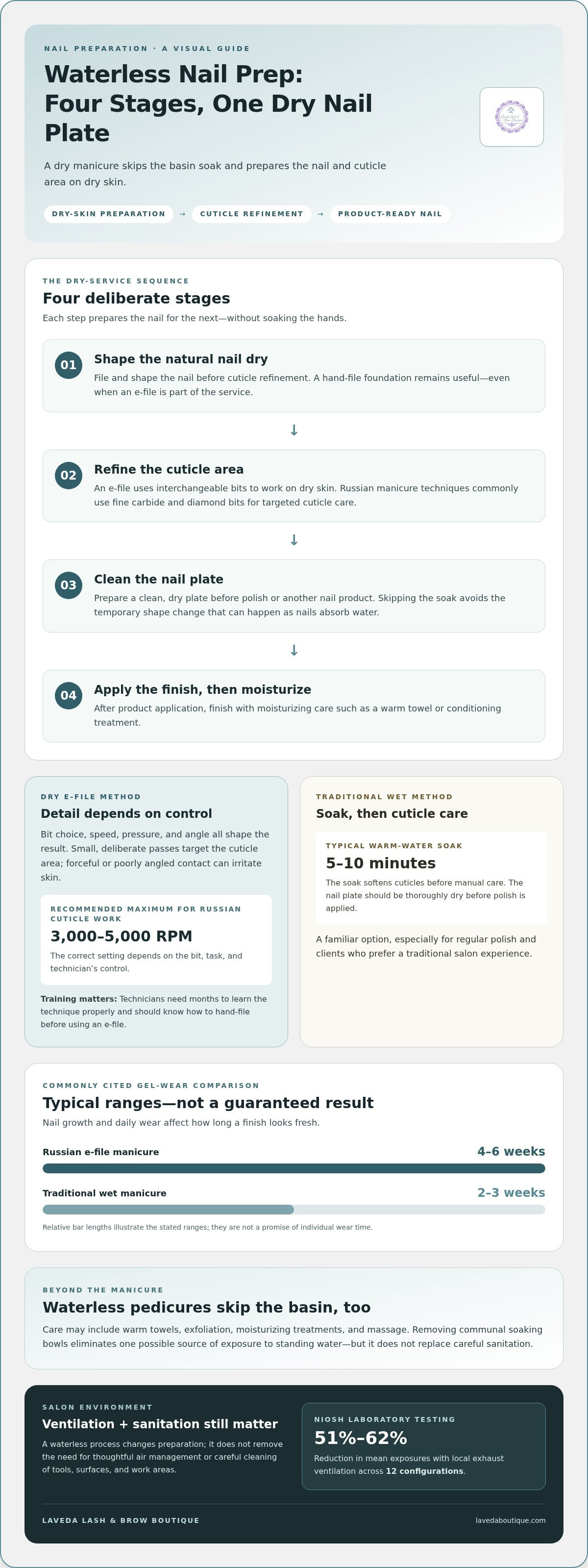
A waterless manicure prepares nails without soaking the hands in a basin. Traditional wet manicures usually begin with a warm-water soak lasting 5-10 minutes. That soak helps soften cuticles before the technician pushes them back or trims them. In a dry service, nail shaping and cuticle refinement happen on dry skin, often with e-file tools. The distinction is the preparation method, not simply whether the service includes moisturizing care.
Water can temporarily change the nail plate. Nails may absorb water and shift shape while wet, then return toward their usual shape as they dry. Applying polish before that change settles may affect how the product sits on the nail. A dry service skips soaking, allowing the technician to prepare a clean, dry nail plate before applying polish. This can support product adhesion, particularly with gel or builder gel.
A typical waterless nail preparation may follow these steps:
Shape the natural nail while it is dry.
Refine the cuticle area with suitable tools and targeted cuticle care.
Clean the nail plate before applying polish or another nail product.
Finish with moisturizing care, such as a warm towel or conditioning treatment.
These approaches can be adapted for manicures and pedicures. A waterless pedicure skips the foot basin and may use warm towels, exfoliation, moisturizing treatments, and massage. Removing communal soaking bowls eliminates one possible source of exposure to standing water, but does not replace careful cleaning and sanitation of tools, surfaces, and work areas.
Wet manicures remain a familiar choice for regular polish. A warm soak gently softens cuticles before manual care and suits clients who prefer a traditional salon experience. For regular polish, the key is applying it to clean, dry nails. After the soak and cuticle work, the technician can dry the nail plate thoroughly before polishing.
Gel wear varies by manicure method in commonly cited comparisons. A Russian e-file manicure is described as lasting 4-6 weeks, while a traditional wet manicure is described as lasting 2-3 weeks. These are typical ranges, not a promise of a specific result. Nail growth and daily wear affect how long a finish looks fresh.
Ventilation matters in nail-service environments, including waterless settings. In laboratory testing, local exhaust ventilation systems reduced mean exposures by 51% to 62% across 12 configurations, according to the National Institute for Occupational Safety and Health. That finding makes ventilation a practical topic to raise when discussing salon conditions. A waterless process changes the preparation routine; it does not remove the need for thoughtful air management.
Technician skill, pressure, speed, bit selection, and angle
Before booking a dry e-file manicure in Washington, DC, ask about the technician’s e-file training and how the technique is adapted to your nails and skin. You can also ask which bits are used for cuticle work and how speed, pressure, and angle are controlled.
E-File Tools and Technician Skill
An e-file is an electric handpiece with interchangeable bits used to refine the cuticle area on dry skin. Russian manicure techniques commonly use fine carbide and diamond bits instead of a bowl soak and metal cuticle pusher. The technician needs to select an appropriate bit and guide it carefully. Unlike a manual wet manicure, this method relies on precise tool control and practiced hand movements.
Safe E-File Speeds and Technique
For Russian manicure cuticle work, the recommended maximum speed is 3,000-5,000 RPM. The correct setting depends on the bit, the task, and the technician’s control. Speed alone doesn’t determine the result: pressure and angle matter, too. A controlled pass keeps the bit moving over the intended area, while forceful or poorly angled contact can irritate skin.
Training shapes the service, too. Technicians need months to learn Russian e-file technique properly, and should know how to hand-file before using an e-file. That foundation helps them prepare the nail without relying on machine work for every step. For example, they can shape the free edge separately from detailed cuticle refinement.
During a dry e-file manicure, the technician works in small, deliberate passes. They assess the cuticle area, choose a suitable bit, and adjust their hand position around each nail. The aim is to target cuticle tissue that needs attention, rather than file aggressively across the surrounding skin. A clean outline comes from careful control, not simply a faster machine.
A traditional wet manicure follows a different sequence. Warm water softens the cuticles, then the technician provides cuticle care with manual tools. Because soaking changes how the skin feels, the technician uses visual assessment and touch when pushing back or trimming. The e-file method instead depends on selecting a suitable bit and controlling its contact with dry skin.
Notice how the technician works, not just which method they name. Deliberate movement, steady positioning, and a bit suited to the task are practical signs of a considered technique. A manicure discussion can also clarify how manicure care is tailored to different preparation methods.
Differences in precision and finish
Precision depends on how the nail and cuticle are prepared, and on how the chosen product is applied. A dry manicure can create a cleaner cuticle line because the skin remains unswollen during detailed work. A traditional wet manicure softens the cuticle with water before manual shaping and care. Either method can produce a polished finish when the steps suit the desired result.
For gel or BIAB, careful nail plate preparation gives the product a surface to bond to. Dry preparation lets the technician work around the cuticle without first swelling the surrounding skin. This can make the boundary between dead cuticle tissue and the living nail bed easier to see. The goal is controlled refinement, not removing extra tissue just to create a sharper outline.
The visual difference is clearest around the polish edge. Precise cuticle work with a dry method can leave a neat margin for product application. The technician can apply gel close to that refined area without coating the surrounding skin. In a wet service, the technician softens the cuticles first, then shapes and cleans the nail before polishing. Both finishes depend on even application and a clean nail plate.
Wear time varies with the method and product. A dry manicure typically holds for two to three weeks, while an e-file manicure can last up to four weeks, depending on nail growth. These figures describe different dry-service categories and should not be treated as interchangeable guarantees. For gel, skipping a soak before application may help the product adhere more effectively to the nail surface.
Choose according to the finish you value. For regular polish and a familiar soak, the wet method offers a straightforward option. For detailed cuticle refinement or structured nail treatments, dry preparation supports greater precision. Nail growth, product choice, and the technician’s application technique also shape the result. In Washington, DC, compare the preparation steps, not just the service label, before deciding which finish suits your manicure.
Waterless manicures and pedicures in Washington, DC
A traditional water manicure in Washington, DC is priced according to the service details, with the price provided after a quote request. Cost factors include the manicure’s scope, polish choice, and added care such as exfoliation or moisturizing treatment.
The key difference is the preparation routine. A wet manicure uses a warm-water soak to soften the hands before cuticle care. A waterless manicure skips the basin and prepares the nail without soaking. Both methods can include shaping, cuticle care, and polish application, but the steps and feel differ.
For regular polish, a traditional soak offers a familiar, relaxing salon ritual. The technician softens the cuticles, completes manual care, then dries the nail plate before applying polish. That final drying step matters because nails can absorb water and temporarily change shape. If you have chosen basin soaks for decades, you may value that established routine.
A dry e-file manicure uses an electric tool to refine the cuticle area on dry skin. This method can suit clients seeking detailed cuticle preparation before gel or structured nail products. The result depends on the technician’s control: bit selection, pressure, and angle all affect how precisely the cuticle area is refined. It is not simply a waterless version of the same sequence.
Waterless services can still feel considered and restorative. Instead of soaking, a manicure may include warm towels, cuticle care, exfoliation, and moisturizing treatments. A waterless pedicure can take a similar approach, combining towel wraps with exfoliation, moisturizers, or massage. Ask which steps are included so the service description matches the experience you want.
Choose a wet manicure for a basin soak and a familiar preparation ritual before regular polish.
Choose dry preparation for e-file cuticle refinement without soaking.
Choose a waterless pedicure if you prefer towel-based care instead of a foot basin.
In Washington, DC, the practical decision involves more than water. Consider whether you prefer a relaxing soak, detailed dry cuticle work, or towel-based care. Then match the polish or nail treatment to the preparation method. For example, a regular-polish appointment and a structured gel service may call for different preparation priorities.
Waterless services remove the communal soak bowl from the appointment, but tool and surface hygiene still matter. Whether the technician uses manual tools or an e-file, the service involves close contact with nails and surrounding skin. The key takeaway: choose the process that fits your preferred experience and assess its quality by the care taken at each step.
The price is provided after a quote request and depends on the service scope, polish choice, and any added care, such as exfoliation or moisturizing treatment.
What sanitation and sterilization practices should manicure salons follow?
Sanitation matters for both dry e-file and traditional water manicures. The preparation method changes, but reusable nail tools still contact hands, nails, and surrounding skin. The Centers for Disease Control and Prevention advises sterilizing shared nail grooming tools before use. This applies to tools used for cuticle care, shaping, and other manicure steps.
Sterilization and surface cleaning serve different purposes. A tidy workstation does not show how tools were processed. Look at the sequence: used instruments should be handled separately from those prepared for the next appointment. Clean hands, a cleared work surface, and properly processed tools each contribute to a considered service.
E-file services add bits and instruments to the sanitation routine. After the procedure, e-file manicure tools and instruments are sterilized in an autoclave with hot steam. This is different from simply wiping a bit or placing it beside the handpiece. A neat setup should keep used tools separate from ready-to-use instruments.
Waterless services remove the shared soak bowl, one possible source of exposure to standing water. That does not replace tool sanitation or careful work-area cleaning. Traditional water services also require attention to the basin and surrounding surfaces. In either setting, notice whether the technician prepares a clean station before starting and separates used implements afterward.
Use these visible steps to understand the routine:
Look for shared nail grooming tools prepared before your service.
Notice whether used implements stay separate from clean instruments.
For e-file work, observe that bits are handled as tools requiring processing.
Check that the work surface is cleared between appointments.
These observations help distinguish a complete sanitation routine from a polished-looking setup. A dry manicure may skip a communal basin, but still uses tools near the cuticle. A traditional manicure may include water, making attention to the basin and surrounding station important. Neither method makes careful instrument handling optional.
For a clear conversation, ask how shared tools are sterilized and how the station is reset between appointments. The CDC guidance offers a straightforward benchmark: shared nail grooming tools should be sterilized before use. For e-file services, ask how bits and instruments are processed after each procedure. A direct answer should describe the steps, not rely on the service label.
Choose a service with a preparation routine you understand and a workstation that appears orderly. Then plan your beauty appointment with sanitation and the manicure experience in mind.
Laveda Lash & Brow Boutique: Lash Extensions
Laveda Lash & Brow Boutique offers beauty services for Washington, DC and Arlington, VA clients looking to complement a polished manicure with a defined eye or brow look. Choose Lash Extensions for added lash definition, or Brow Lamination to shape and refine your brows. These services complement, rather than replace, the manicure methods compared above.
Turn to the boutique when planning coordinated beauty appointments or when you want to focus on lashes and brows alongside your nail care. Choose the service that matches your desired look and make it part of your personal routine.
Visit lavedaboutique.com to explore the boutique’s services or get in touch.
Choose the Manicure That Fits Your Routine
Let your preferred appointment experience guide your next step. When choosing between a dry e-file manicure and a traditional water manicure in Washington, DC, consider both the finish you want and how you like nail care to feel. A clear preference helps you choose a service that fits your routine.
For ongoing beauty care in Washington, DC and Arlington, VA, Laveda Lash & Brow Boutique offers Mani Pedi services, alongside Lash Extensions and Lash Lift. Choose the service that matters most to you, whether that is nail care or a complementary lash treatment.
Contact Laveda Lash & Brow Boutique to explore your next beauty appointment. Take the next step with confidence and choose the experience that feels right for you.
Frequently Asked Questions
What Is Traditional Wet Manicure?
A traditional wet manicure starts with a warm-water hand soak, commonly lasting 5-10 minutes. The water helps soften cuticles before manual care, such as pushing them back or trimming them. In Washington, DC, this familiar salon method can suit clients who prefer a soak before regular polish. A pedicure may also use a basin, but the hand-soak step specifically defines a wet manicure.
Dry Manicure vs Wet Manicure: What's the Difference?
A dry manicure prepares nails without a basin soak, while a wet manicure uses warm water before cuticle care. For example, a technician may use e-file bits to refine the cuticle area during a dry service, or manual tools after soaking during a wet service. The choice affects the preparation sequence and the cuticle’s appearance during treatment, not simply whether the appointment includes moisturizing care.
Which Clients Are Suitable for Each Technique?
Your preferred feel and nail finish help guide the choice. A wet manicure suits someone who enjoys a warm soak and wants regular polish. A dry e-file method may suit someone seeking detailed cuticle refinement or structured nail treatments. Skin and nail type also matter because they influence how cuticle care should be approached. In either method, the technician’s control and technique shape the service.
Which Manicure Lasts Longer?
An e-file manicure typically lasts up to four weeks, depending on nail growth. A dry manicure is also described as typically holding for two to three weeks. For gel services, Russian manicures are commonly associated with 4-6 weeks of wear, compared with 2-3 weeks for traditional wet manicures. These ranges describe different service types, so compare the specific technique and product rather than relying on “dry” alone.
Which Manicure Method Is Right for You?
When comparing a dry e-file manicure with a traditional water manicure at a Washington, DC salon, start with your preferred preparation and finish. If you enjoy a soak and usually wear regular polish, a traditional wet manicure fits that routine. If you want detailed cuticle work or a structured treatment, dry preparation may better match your priorities. Keep those preferences in mind when choosing your appointment.
Which Method Creates a Cleaner Finish?
Dry manicures are often associated with a more precise cuticle line because the surrounding skin remains unswollen during refinement. This can help the technician distinguish dead cuticle tissue from the living nail bed. A wet manicure can still create a polished result, especially with regular polish, but soaking softens and swells the skin. The final appearance also depends on controlled cuticle care and even product application.
Which one should you choose?
To choose between a dry e-file manicure and a traditional water manicure at a Washington, DC salon, consider the preparation steps and the finish you prefer. Choose the wet method for a familiar soak and regular polish; choose dry e-file preparation for detailed cuticle work or structured nail treatments. Match the method to your routine and the technician’s assessment of your skin and nails.
Why Choose a Waterless Nail Service?
A waterless service skips the shared soaking bowl and may replace the basin with warm towels, exfoliation, cuticle care, and moisturizing treatments. For example, a waterless pedicure can include towel wraps and massage without soaking the feet. This changes the appointment routine but does not remove the need for tool and workstation sanitation. Choose it if you prefer targeted care without a communal soak.

Different vehicle models benefit from survival race different upgrade priorities because their starting attributes may emphasize speed, handling, durability, or versatility.