
How to Safely Remove Lash Extensions: Do's and Don'ts
A quick tug can cost more than the extensions. If they feel uncomfortable, look uneven, or seem ready to come off, it’s natural to wonder how to remove lash extensions without damaging your natural lashes. The safest next step depends on whether you’re wearing salon-applied individual extensions or DIY clusters, because the adhesives and removal methods differ.
An easy home solution can sound appealing, especially when professional removal feels inconvenient. But steam, oils, and lash removers aren’t interchangeable. Methods intended for strip lashes or DIY clusters may not safely dissolve professional-grade adhesive. Pulling, scraping, or using the wrong product near your eyes can irritate delicate skin and put natural lashes at risk.
This guide explains what to avoid, how professional removal differs from at-home cluster removal, and what to do if extensions are irritating your eyes. You’ll learn when home removal is risky, how to avoid tugging, and which symptoms call for prompt attention.
Table of Contents
How to remove lash extensions safely: start by identifying what you have
Uncomfortable, grown-out, or uneven lashes can make you want a quick fix. Before deciding how to remove lash extensions, identify what’s on your lash line. The safest next step depends on how the lashes were applied and which adhesive was used.
Salon-applied extensions are individual fibers attached to natural lashes with adhesive, rather than a single strip. For a general overview of eyelash extensions and common application types, remember that knowing the type is only a starting point. It doesn’t make salon-bonded extensions safe to pull off at home.
Keep one principle in mind: don’t pull, pick, or force bonded extensions off. Your natural lashes are part of the bond, so tugging can remove or weaken them. If you can’t tell what type you have, don’t test the attachment by pulling. A lash professional can help identify the set and discuss a safer next step.
Professional extensions versus temporary lash clusters
These products may look similar, but they’re applied differently and don’t share one removal routine. Professional extensions are attached individually to natural lashes with professional adhesive. Temporary clusters are grouped lash fibers, and their bonding products and wear instructions vary by product.
Check the packaging or instructions for your clusters, and follow the maker’s removal directions for that exact product. Don’t apply cluster-removal advice to salon-bonded extensions. If you’re wearing professional extensions, focus on protecting your natural lashes and getting guidance suited to professional adhesive, rather than trying a method intended for another product.
When should you remove lash extensions?
Removal can be a routine choice. You may want a different look, prefer a break from extensions, or find that natural lash growth has left the set looking uneven. Those cosmetic reasons don’t mean you need to rush or remove the lashes yourself. Avoid picking at individual extensions just because they’ve grown away from the lash line.
Discomfort calls for a different response. Mild dissatisfaction with the look isn’t the same as persistent or significant discomfort around the eyes. Don’t try to diagnose the cause or experiment with products near the eye area. Stop manipulating the lashes and seek prompt professional advice if you’re concerned about a reaction.
For a style change: Arrange a considered removal rather than pulling off extensions one by one.
For an uneven-looking set: Avoid trimming, tugging, or picking at the grown-out fibers.
For a concerning eye-area reaction: Stop experimenting and seek prompt advice from an appropriate professional.
Identifying the lash type helps you avoid following instructions meant for a different product. If it’s a salon-applied set, protect your natural lashes and choose guidance suited to professional adhesive.
Why lash extension adhesive makes at-home removal difficult
Professional lash adhesive is designed to keep extensions attached through normal wear. That durability is useful while you’re wearing the set, but removal takes more than making a lash feel loose. Adhesive bonds individual extensions to natural lashes, so the bond needs to be released carefully rather than pulled apart.
Loosening an extension isn’t the same as safely releasing its adhesive bond. A fiber may shift or slide while adhesive remains attached to your natural lash. Pulling at that point can strain the natural lash, and repeated rubbing can irritate the delicate skin around your eyes. A method that seems to be working isn’t necessarily removing the set safely or completely.
Can oil or steam remove professional lash extensions?
Online advice often suggests oil or steam because these approaches may soften makeup or affect some residue. Professional adhesive bonds can respond differently, however, and neither method guarantees that each extension will release in a controlled way. A few lashes shifting doesn’t mean all the adhesive has dissolved.
Results can vary. Trying again with more oil, more rubbing, or repeated pulling adds avoidable risk without ensuring complete removal. Don’t expose your eyes to hot steam as a removal technique. Heat near the eye area can be uncomfortable and doesn’t provide the precise control needed to release individual bonds.
For context on why the eye area deserves care, the American Academy of Ophthalmology’s guidance on eyelash extension safety discusses concerns such as reactions to adhesive and potential harm to natural lashes. It’s a useful reminder that an at-home experiment can affect more than the appearance of the set.
Why professional adhesive remover needs careful handling
Professional removers are made to dissolve extension adhesive, but that doesn’t make them suitable for unsupervised use near the eyes. Effective use depends on controlled placement and careful removal. If product spreads beyond the intended area or enters the eye, it may cause irritation or injury. Don’t use nail polish remover, household solvents, or any product that isn’t intended for lash extension adhesive.
Even a product sold as a lash remover doesn’t guarantee safe DIY removal. Packaging directions may not account for the placement and bonding of a salon-applied set. Avoid applying a strong remover close to your eyes without appropriate expertise. If an attempt causes discomfort, stop immediately. Don’t apply more product or try to work through the sensation; seek appropriate professional advice instead.
If you’re unsure how to remove lash extensions without stressing your natural lashes, a professional assessment is a safer next step than repeating an uncertain method. Laveda Lash & Brow Boutique offers lash artistry at its Washington, DC boutique. Explore professional lash services as you consider your next step.
At-home removal versus professional removal: compare the safer options
Choosing how to remove lash extensions is less about finding the most convenient method and more about matching the approach to the adhesive and application. For salon-bonded extensions, professional removal offers more control over how the adhesive is addressed. At home, the safer goal is to avoid making the situation worse, not to force the extensions off.
Eye-area products deserve careful use. The FDA’s guidance on eye cosmetic safety covers cosmetics used around the eyes and potential irritation or allergic reactions. Avoid improvising with household products or using a strong remover near your eyes without appropriate expertise.
When professional removal is the better choice
Seek professional guidance if salon-applied extensions remain firmly attached, the set has become uneven and tempting to pick at, or an attempt to remove it feels uncomfortable. Careful handling can help you avoid tugging or repeatedly rubbing the lash line. That matters because forcing a resistant bond can place unnecessary stress on natural lashes.
For readers in Washington, DC, and Arlington, VA, Laveda Lash & Brow Boutique brings lash artistry to the local community. The boutique has served more than 12,000 lash clients. Explore its professional lash artistry as you consider a safety-first next step.
What at-home care can and cannot do
If you’ve already tried a home method, don’t panic or keep repeating it. Stop pulling and rubbing. Return to gentle cleansing, and leave any extensions that remain firmly bonded in place. This won’t remove the set, but it avoids adding more force while you decide what to do next.
Natural lashes shed over time, so an extension may loosen as the lash it’s attached to reaches the end of its growth cycle. That process varies and isn’t a removal schedule. Don’t pull at a loose-looking fiber or assume that oil or another household product will dissolve its adhesive. Home care can limit unnecessary handling; it can’t promise complete removal or preserve every natural lash.
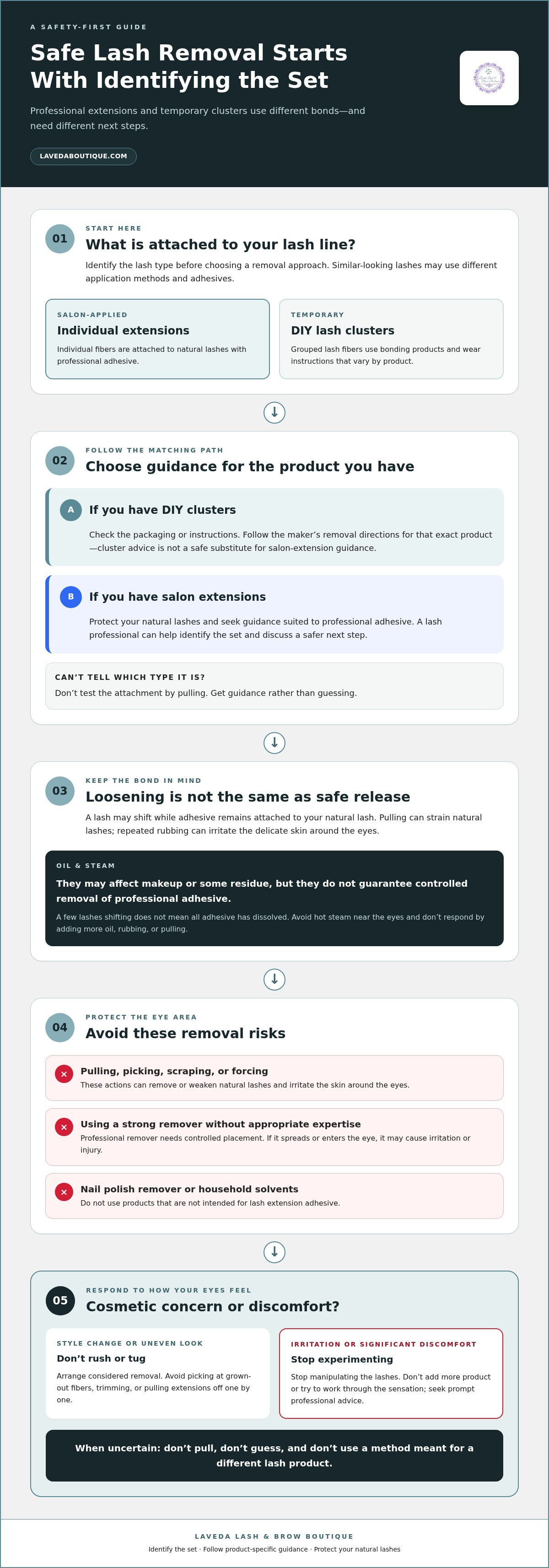
Safe Steps to Remove Lash Extensions Now
If your extensions feel uncomfortable or look uneven, pause before trying to take them off. The safest immediate response is simple: stop, don’t tug, and get guidance. These steps help you avoid adding strain while deciding what to do next. They aren’t a home removal method for salon-bonded extensions.
A simple safety-first sequence
Stop pulling and picking. Don’t tug at an extension, even if it looks loose or has grown away from the lash line. Pulling can put tension on the natural lash attached to it.
Wash your hands. Clean hands help limit the transfer of dirt or product as you care for the eye area. Avoid touching the lashes more than necessary.
Remove makeup gently, if needed. Use a light touch around the eyes. Don’t rub across the lash line, pull on attached extensions, or try to scrub away adhesive residue.
Skip tools and remover. Keep tweezers, scissors, scraping tools, and lash adhesive remover away from the lash line. These can make it easier to injure delicate skin or disturb natural lashes.
Choose your next step based on how you feel. If there’s no irritation or discomfort, leave firmly attached extensions alone while arranging professional guidance. If something feels wrong, stop experimenting and seek appropriate advice.
These steps focus on reducing unnecessary handling, not dissolving the adhesive. If you’re searching for how to remove lash extensions at home, remember that a gentle routine can help you avoid worsening the situation, but it can’t safely release a salon-bonded set.
When to stop and seek prompt help
Don’t try another product or removal attempt if you have persistent pain, notable swelling, worsening redness, or any change in vision. These symptoms can have different causes, and a short article can’t determine what’s happening. Seek prompt advice from an appropriate medical professional rather than trying to diagnose the problem yourself.
For urgent or severe eye symptoms, seek urgent medical care. Don’t delay care to finish removing extensions, and don’t apply more remover near the eye. If you’ve already tried a home method, stop there. Tell the professional what you applied and when, if you know. That information may help them advise you on an appropriate next step.
If there are no concerning symptoms but salon-applied lashes remain firmly attached, arrange professional lash guidance instead of repeating a home attempt. Laveda Lash & Brow Boutique serves clients in Washington, DC, and Arlington, VA, with a focus on lash artistry. Explore Laveda’s lash services as you consider your next step.
Choose a professional next step for lash extension removal in Washington, DC
If salon-applied extensions are still attached, a professional assessment is a calmer next step than forcing them off at home. A lash professional can look at the set, hear what feels uncomfortable or uneven, and discuss an appropriate way forward. This keeps the focus on your comfort and natural lashes, not on getting an instant result.
Laveda Lash & Brow Boutique brings lash artistry to Washington, DC, and has served more than 12,000 lash clients. Founded in 2018, the boutique offers a knowledgeable local perspective for clients deciding what to do with their extensions. For background on lash application and service context, explore this Washington, DC lash extensions guide.
What to expect from a professional lash appointment
A professional conversation can begin with the details that matter: what type of extensions you’re wearing, what concerns you’ve noticed, and whether you’ve already tried anything at home. A lash professional can assess the extensions and discuss an appropriate next step. Share any discomfort clearly, and mention products you’ve used. Careful handling and clear communication keep natural-lash protection central, without assuming every set or concern calls for the same response.
If you’re unsure how to remove lash extensions, you don’t need to arrive with a solution already chosen. Explain whether your main concern is an uneven appearance, a style change, or discomfort. If you’re experiencing significant or worsening eye-area symptoms, seek appropriate medical advice rather than treating a lash appointment as a substitute for care. A beauty professional can discuss lash options, but shouldn’t diagnose an eye condition.
If you are considering a different lash look
Removal and choosing your next look are separate decisions. A lash lift is a different service from extensions, so it may be worth exploring if you’re considering another approach to your lashes. It isn’t a removal method or a reason to rush a change. Give yourself room to decide what suits your preferences and your natural lashes.
For a clearer comparison of those style options, read the lash lift versus extensions comparison. It can help you consider the difference before choosing what you’d like to explore next.
Take the next step at your own pace. If you’re in Washington, DC, explore Laveda’s lash services and artistry when you’re ready to discuss a look that feels right for you.
Choose a lash plan that feels right for you
Your next step doesn’t need to be decided in a hurry. Give your natural lashes room to recover from the uncertainty of a DIY attempt, and consider what you want from your next look before making a change. If you’re still weighing how to remove lash extensions, let comfort and careful guidance shape that decision rather than pressure to get them off immediately.
A professional conversation can also help you think beyond removal. You may want to continue with extensions, explore a lash lift, or take a break. A clear discussion of your preferences gives you a more considered starting point for whatever comes next.
Laveda Lash & Brow Boutique offers lash artistry in Washington, DC. Explore professional lash services at Laveda and choose a next step with confidence. Your lashes deserve a thoughtful approach, and you can move forward at a pace that feels comfortable.
Frequently Asked Questions
Can I remove lash extensions at home with olive oil?
No. Olive oil may affect makeup or some residue, but it can’t guarantee that salon adhesive will release in a controlled way. If you’re researching how to remove lash extensions, don’t treat oil as a removal product or keep rubbing when lashes don’t shift. Repeated handling can irritate the eye area. If extensions remain attached or the process feels uncomfortable, stop and seek guidance from a lash professional.
Is it safe to pull off lash extensions that are already loose?
No. A loose-looking extension may still be connected to a natural lash, so pulling can cause discomfort or remove that lash before it sheds naturally. Don’t test the bond with your fingers, tweezers, or another tool. If one lash is catching on clothing or bothering you as you blink, avoid manipulating it and arrange professional guidance to decide on a suitable next step.
How long does professional lash extension removal take?
There isn’t one reliable time estimate for every set. The amount of adhesive and the extensions’ condition can affect what the appointment involves. A lash professional can assess your lashes and explain what to expect. Share whether you’ve used any products or tried to remove extensions yourself. Don’t rush a home attempt to meet a time estimate; careful handling around the eyes matters more than speed.
What happens if lash extension remover gets in my eye?
Stop using the remover immediately and follow the product label’s instructions for eye exposure. Don’t rub your eye or apply more product. If pain, redness, irritation, or vision changes occur or persist, seek prompt medical advice; for urgent or severe symptoms, seek urgent medical care. Keep the product packaging available so you can share its instructions and ingredients with the medical professional. Don’t rely on online removal tips for eye exposure.
Can I wear new lash extensions right after removing the old ones?
Not necessarily. Whether a new set is appropriate depends on the condition of your natural lashes and how the previous extensions were removed. Don’t assume that a new application should happen immediately. Ask a lash professional to assess your lashes and discuss timing and suitable options. If your lash line or eyes are irritated, prioritize appropriate care before considering another cosmetic service, and explain any symptoms or products involved.
Should I remove lash extensions if my eyes are red or itchy?
Don’t pull extensions off at home because your eyes are red or itchy. Stop applying products around the eye area and seek appropriate guidance, especially if symptoms persist, worsen, or occur with swelling, pain, or vision changes. For urgent or severe symptoms, seek medical care promptly. Redness and itching can have different causes, and an article can’t diagnose them. Avoid applying remover while the area is irritated.