
Microblading in Arlington, VA: Artist Credentials and Skin Fit

When finding a reputable microblading artist in Arlington, VA, weigh healed-brow feedback alongside training, licensing, insurance, and a clear assessment of skin suitability. A microblading appointment usually takes about 2-3 hours, and healing can take several weeks, so the artist’s work and aftercare guidance matter as much as the initial result.
It’s reasonable to want brows that look balanced and natural, but polished photos alone don’t show how results heal or whether an approach suits your skin. Look for client feedback about healed results and the overall experience, then consider the artist’s training and how clearly they explain the process.
This guide shows how to assess reviews, permanent makeup experience, licensing, insurance, and skin fit when comparing Arlington artists. You’ll also learn what to consider before treatment and how aftercare supports healing, so you can make a more informed decision about your brows.
Table of Contents
Client feedback about eyebrow results
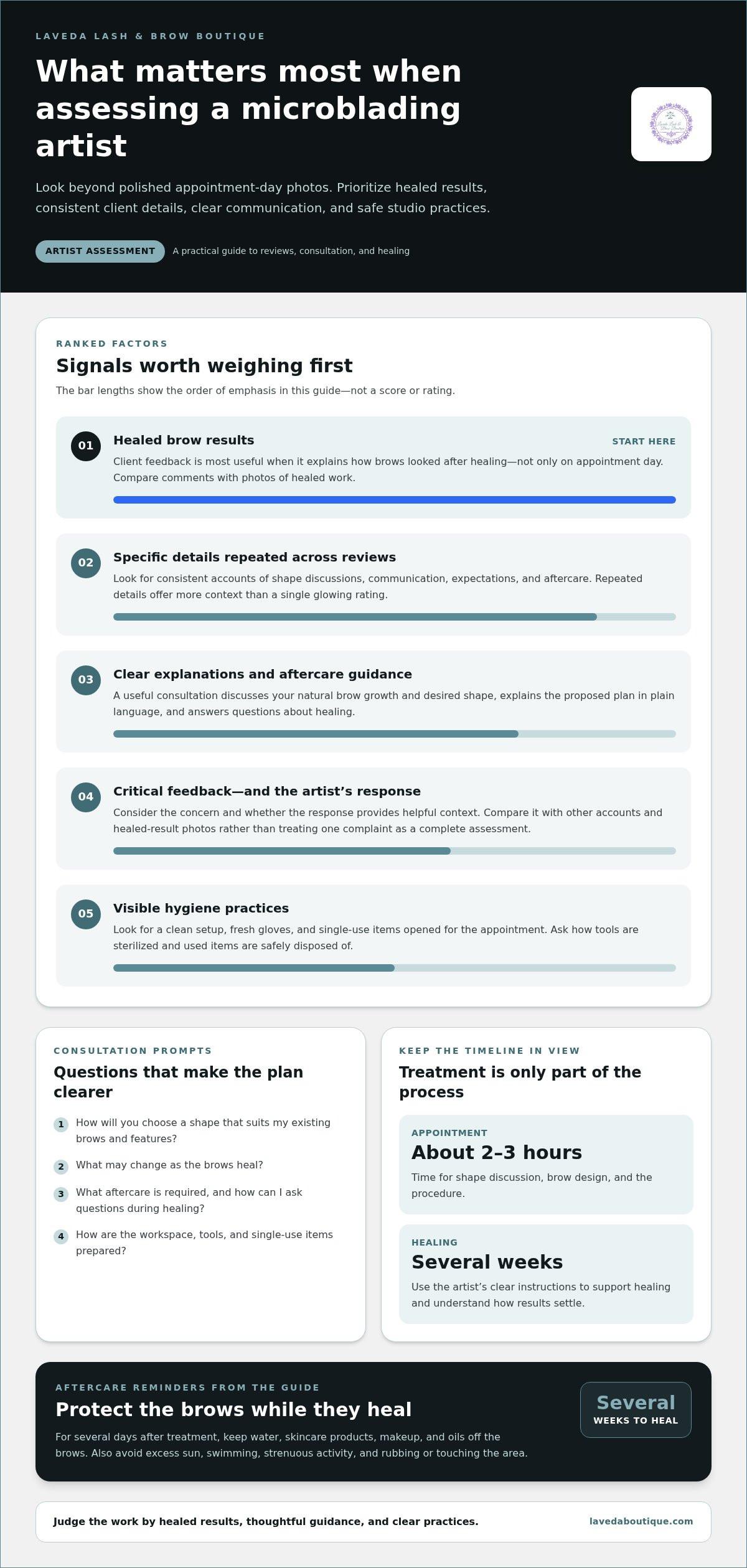
Client feedback is most useful when it describes healed brows, not just the impression on appointment day. When finding a reputable microblading artist in Arlington, VA, compare detailed comments with photographs and the artist’s explanation of the process. A review that says “natural shape” tells you more when it also describes how the brows looked after healing.
Look for specific observations across multiple reviews. One client might mention that the artist discussed brow shape before beginning; another might describe receiving clear aftercare instructions. Repeated, consistent details can reveal how the artist communicates and manages expectations. A single glowing rating, by contrast, offers little context about the finished result.
Read critical feedback just as carefully. Focus on the concern and the artist’s response, such as whether a client describes confusion about healing or difficulty understanding aftercare. A thoughtful response that explains the process can provide useful context. Don’t treat one complaint as a complete assessment; compare it with other accounts and available photos of healed results.
What questions should I ask during a microblading consultation? Ask how the artist chooses a brow shape, what result suits your existing brows, and what may change during healing. Request a clear explanation of aftercare and how the artist handles questions during the healing process.
Use the consultation to see whether the conversation is specific to your features. Notice whether the artist discusses your natural brow growth and desired shape before recommending an approach. A useful consultation explains the proposed plan in plain language, rather than relying only on a style label or an edited photograph.
What hygiene and sterilization practices should a reputable microblading studio follow? Ask how the workspace is cleaned, how tools are sterilized, and whether blades and other single-use items are opened for each appointment. Look for a clean setup, fresh gloves, and a clear answer about safe disposal of used items.
Don’t infer good hygiene from attractive décor or online praise. During the appointment, observe whether the artist prepares the work area before treatment and keeps clean supplies separate from used tools. If an explanation or visible practice raises concern, pause rather than proceeding without clarity.
How long does microblading take to heal, and what aftercare is required? Healing can take several weeks. For several days after treatment, avoid water, skincare products, makeup, and oils on the brows. Also avoid excess sun, swimming, strenuous activity, and rubbing or touching the area.
Reviews that mention healing can help you judge how clearly the artist prepares clients for that period. Compare those accounts with the written aftercare instructions provided during consultation. Look for practical guidance about everyday situations, such as keeping makeup away from treated brows, rather than broad advice without examples.
Permanent makeup services
Permanent makeup describes cosmetic techniques that add pigment to brows or other features. For brows, the method affects the finished texture and definition. Compare the technique itself, not just the service name. Ask the artist to explain how the chosen approach relates to your existing brow hair, preferred shape, and desired finish.
How should I compare microblading with powder brows and combo brows? Microblading creates hairlike strokes, while powder brows use a shaded effect; combo brows combine strokes and shading. Compare healed examples of each technique, then consider which appearance best matches your brow goals and natural hair pattern.
Microblading uses fine strokes to imitate individual brow hairs. Powder brows create a more filled-in, makeup-like appearance through shading. Combo brows bring both effects together, often using strokes near the front and shading in other areas. These descriptions help you discuss visual preferences, but the artist’s portfolio shows how each method looks in practice.
A focused consultation should turn your preferences into a clear plan. Follow these steps:
Describe the brow shape and level of definition you want.
Review healed examples of microblading, powder brows, and combo brows.
Ask why the artist recommends a specific technique for your brow pattern.
Discuss how pigment placement and aftercare affect the finished appearance.
Microblading usually takes about 2-3 hours. That appointment allows time for discussing the shape, planning the brow design, and performing the procedure. Ask how each stage fits into the scheduled appointment, so you understand what will happen before treatment begins. Clear explanations help you assess whether the proposed technique matches your expectations.
Results can last 2-3 years with proper aftercare and touch-up appointments. This timeframe makes technique selection and ongoing care relevant parts of the decision. Ask what aftercare involves and how touch-ups relate to maintaining the result. Avoid judging a method from fresh work alone; healed examples offer a more useful view of how pigment settles.
Use the consultation to compare a specific example with your own goals. If you prefer individual-looking strokes, discuss microblading and review healed work using that technique. If you want a shaded finish, ask to see powder brows. If you like both effects, review combo brows. A clear recommendation should connect the technique, your visual goal, and the artist’s examples.
Explore the microblading service as one option for enhancing brow definition. A clear understanding of the technique can help you decide what to discuss during your appointment.
Artist licensing and insurance
Assess training, credentials, and insurance as separate parts of an artist’s professional record. A permanent makeup certificate documents training; it does not, by itself, explain every credential relevant to a service. Ask what each document represents, who issued it, and how it relates to microblading. Clear answers help distinguish education from other professional documentation.
Specific training details add useful context. Samira received permanent makeup training and certification from the Esthetics Institute in early 2016. She holds over 15 permanent makeup certifications. Use details like these to understand an artist’s education, then ask which training covered the microblading technique shown in their portfolio. The connection between education and actual work matters more than a credential count alone.
Ask the artist to identify the credential they hold and the organization that issued it. Review the name, credential type, and scope together. For example, a document focused on a different beauty service may not demonstrate microblading-specific education. Don’t treat the words “licensed” and “certified” as interchangeable; ask what each means in the artist’s professional context.
Ask directly about insurance, too. Find out whether the artist carries professional liability coverage related to cosmetic tattooing, and request an explanation of what the policy covers. A policy title alone may not clarify whether microblading falls within its scope. Ask how coverage applies to the procedure, the work setting, and concerns that could arise during or after an appointment.
Use this practical checklist during a consultation:
Match the artist’s name to the name on training and credential documents.
Ask which education specifically covered microblading and pigment placement.
Clarify whether insurance applies to the procedure being discussed.
Notice whether answers are direct, consistent, and easy to understand.
Keep your questions precise. “What credential applies to this procedure?” is more useful than asking whether someone is qualified in general. Likewise, ask about the type of insurance coverage rather than relying on a broad assurance. A professional discussion should connect each document to the service, such as microblading, and explain its relevance without confusing training, licensing, and insurance.
Compare those answers with the artist’s work and consultation approach. A well-presented certificate cannot show how brows heal, while a polished portfolio cannot explain insurance coverage. Evaluate each independently. For example, confirm that microblading-specific training, relevant documentation, and clear coverage information all relate to the same service. This gives you a more complete basis for choosing an artist in Arlington.
Candidate suitability and skin types
Skin characteristics and personal health history should inform a microblading consultation. Discuss your goals, current skin concerns, and the artist’s reasoning before settling on a technique.
Suitability Across Skin Types
Ask how your skin’s texture and condition affect the proposed brow design. Discuss whether your skin is oily, dry, sensitive, or prone to irritation, and ask to see healed work on clients with comparable characteristics. The goal is a specific conversation about your skin, natural brow hair, and desired finish, not a one-size-fits-all recommendation.
Use the consultation to share details that could affect the treatment area. Point out active irritation, previous reactions to cosmetic products, or changes in your brow skin. Ask the artist to explain how those observations inform the technique and pigment plan. A useful answer connects your features with the proposed approach instead of relying on a generic description of “suitable skin.”
Compare the recommendation with your desired result. If you want fine, hairlike strokes, ask how the artist expects that look to translate to your brow area. Review healed examples, not just fresh work, and ask what differences the artist sees between the example and your skin. These are concrete points to consider before agreeing to the procedure.
Bring a short list of discussion points: skin concerns, brow history, desired shape, and examples of results you like. Tell the artist about previous brow procedures and any products that have caused a reaction. These details make the consultation more individualized. Ask the artist to explain any recommended change, such as adjusting the shape or choosing another approach.
Risks and Contraindications
Microblading involves skin penetration, so discuss possible irritation, infection, pigment sensitivity, and uneven healing. Share allergies, current skin concerns, and relevant health history before treatment. Ask what circumstances would lead the artist to postpone or decline the procedure, and request a clear explanation of any concern specific to your skin or treatment area.
Ask direct questions to understand the limits of the appointment. For example, ask how the artist responds to unexpected skin irritation and what signs after treatment should prompt you to seek appropriate medical advice. Don’t withhold relevant details to secure an appointment. A careful suitability discussion considers your circumstances and the treatment area rather than assuming every client is an appropriate candidate.
Before deciding, ask the artist to summarize the identified risks, expected healing, and aftercare in plain language. Confirm you understand which products and activities to avoid during healing. If the explanation doesn’t address a concern you raised, pause and request clarification before proceeding. That final review gives you a clear record of the advice and the plan for your brows.
What should I look for in before-and-after microblading photos?
Before-and-after photos can show an artist’s design choices, stroke placement, and visual consistency. Compare each pair with your own goals. A close-up of the brow area is more useful than a distant portrait, while a clear “before” image helps you understand what changed. Treat each image as an example, not a promise of your personal result.
First, check whether the paired images allow a fair comparison. Look for similar angles, expressions, and lighting. A raised brow or turned head, for example, can make the shape appear different. Strong filters, heavy makeup, and dramatic shadows can also obscure details. Prioritize photos where both brows are clear and you can assess their shape against the client’s natural features.
Use this viewing sequence for each portfolio example:
Compare the brow shape and balance in the before and after images.
Inspect the strokes closely for visible definition and an intentional pattern.
Look for images labeled as healed, not only immediately after treatment.
Compare several clients to see how the artist adapts designs.
Freshly completed brows and healed brows show different points in the process. Check that the time point is clearly identified, then compare like with like. Don’t judge one artist’s healed result against another artist’s immediate post-treatment image. A portfolio with several clearly presented examples helps you understand the range of work shown.
Check for variety, not just the most polished image. Compare examples with different natural brow densities, starting shapes, and desired levels of definition. If every photo shows a nearly identical brow, you have less evidence of how the artist approaches different starting points. Ask which example most closely resembles your brows, and discuss relevant differences before choosing a design.
Notice how the artist presents the portfolio. Consistent framing makes comparisons easier, while clear labels distinguish techniques and healing stages. A close crop should still show the full brow shape, including the front, arch, and tail. If those areas are missing, it may be difficult to assess overall balance. Use specific observations, such as stroke direction or shape, to guide your questions.
Bring one or two reference examples to your consultation and explain what you like in each. Focus on a feature, such as a soft front or defined arch, rather than asking for an exact copy. To discuss your brow goals, explore microblading services at Laveda Lash & Brow Boutique and consider which portfolio details matter most to you.
Instead of expecting a direct copy of someone else’s brows, focus on how the artist customizes each treatment to the individual. An artist’s background can add context to your design discussion, but it does not replace reviewing clear, healed examples. Samira spent a decade as a fashion designer in New York before founding her beauty studio. If you consider that experience, keep the conversation focused on brow details you can assess in the portfolio and the features you want to discuss. Ask how the proposed shape relates to your natural brows, and use photos to clarify the finish you prefer rather than treating career history as a guarantee.
Laveda Lash & Brow Boutique: Lash Extensions
Laveda Lash & Brow Boutique offers Lash Extensions and Brow Lamination for clients refining their beauty routine alongside their brow plans. Choose Lash Extensions to enhance the appearance of your lashes, or consider Brow Lamination for a polished brow finish. These services address different preferences from microblading, so choose them when your goal is lash enhancement or brow styling rather than pigment-based brow definition.
If you’re comparing options, identify the result you want first: added emphasis around the eyes or a styled brow appearance. That distinction helps you select a service aligned with your goals. Visit lavedaboutique.com to explore Laveda Lash & Brow Boutique.
Choose Your Next Step With Confidence
As you continue finding a reputable microblading artist in Arlington, VA, turn your research into a clear decision process. Write down the qualities that matter most, then use them to compare your consultation notes. This keeps your choice grounded in your priorities rather than the most striking photo or strongest first impression.
Before booking, take time to consider whether the proposed brow approach suits your goals and comfort level. A thoughtful decision includes knowing what you want to ask next and feeling clear about the answers you’ve received. If you’re also planning a broader beauty routine, Laveda Lash & Brow Boutique offers Lash Extensions, Lash Lift, and Mani Pedi.
Take the next step at your own pace. Contact Laveda Lash & Brow Boutique to discuss your beauty service needs and explore your options.
Frequently Asked Questions
How do I verify a microblading artist's Virginia license and credentials?
Ask the artist to identify the credential they hold and the organization that issued it. Compare the artist’s name and credential details with the original document, then use the issuing organization’s official verification process. Treat a training certificate as evidence of training, not automatically as a state license. Ask which education specifically covered microblading, and keep the answers distinct: licensing, procedure-specific training, and insurance address different aspects of professional practice.
Which Arlington, VA microblading artists have strong recent reviews and portfolios?
Choose candidates by matching current client feedback with artist-specific examples of healed results, rather than relying on a “top” label. Look for portfolios showing different brow shapes and natural starting points, then compare those results with detailed reviews of the client experience. Check that the portfolio belongs to the person who would perform your procedure. This helps you assess Arlington options without treating popularity or a high rating as proof of individual fit.
How can I check whether an Arlington microblading artist's reviews are authentic and recent?
Look for reviews posted on different dates that describe specific experiences, such as appointment communication or follow-up guidance. Compare the service the reviewer names with the artist’s portfolio and business profile. Repeated wording, clusters of similar posts, or praise without concrete details offer less useful context. Read positive and critical comments, and note whether the artist responds directly to concerns rather than relying on star ratings alone.


Comments