
Is Builder Gel Better Than Dip Powder for Nail Health?

The gentler option may have less to do with the product in the pot than with how it’s applied and removed. If you’re asking, is builder gel better than dip powder for nail health, the answer depends on your nails, the technique, and the upkeep.
It’s natural to want a clear winner. Builder gel is more flexible and can often be filled as nails grow, while dip powder creates a more rigid enhancement that typically needs to be soaked off and reapplied. But aggressive filing, peeling product away, or rough removal can weaken natural nails with either method.
This guide compares how builder gel and dip powder interact with natural nails, what application and removal can mean for nail condition, and how maintenance affects your choice. You’ll also find practical points to consider if your nails are thin or prone to breakage, when a break from enhancements may help, and when to seek professional guidance. Use these details to weigh your nail condition against the look and upkeep you prefer.
Table of Contents
Builder Gel vs. Dip Powder for Nail Health: What the Comparison Really Means
How Application, Maintenance, and Removal Can Affect Nail Health
Builder Gel vs. Dip Powder: Compare Nail Health, Upkeep, and Trade-Offs
How to Choose Between Builder Gel and Dip Powder More Thoughtfully
Professional Nail Care in Washington, D.C. and Arlington, VA
Builder Gel vs. Dip Powder for Nail Health: What the Comparison Really Means
Builder gel and dip powder can both add structure, length, or a polished finish, but they use different enhancement systems. Builder gel is shaped over the natural nail or an extension. Dip powder combines layers of powder with a bonding liquid to build a hardened coating. Formulas and salon systems vary, so the product name alone doesn’t tell you how the service will affect your nails.
In brief: builder gel is a sculptable gel enhancement, while dip powder combines powder and bonding liquids to create a hardened layer over the nail. Both sit on the nail plate, the hard surface that forms the visible part of your nail. That plate is the foundation beneath the enhancement, so its preparation and treatment matter.
What is builder gel, and how is it used?
Builder gel is applied in controlled layers and shaped over the natural nail or an extension to create an overlay or added structure. Depending on the product system, it may need to be cured under a UV or LED lamp. Curing requirements and application techniques vary, so the product’s directions matter.
The result can range from a natural-looking overlay to a more structured enhancement. Appearance doesn’t reveal how gently the nail was prepared, and a glossy finish isn’t evidence of a healthier application. Nail condition, product choice, and service technique all affect the experience.
What is dip powder, and how does application differ?
In a typical dip application, a bonding liquid is applied to the nail before it’s coated with powder. The process is repeated to build coverage and thickness, and additional liquids may be used to set or finish the layers. Exact steps vary by system, so the service should follow that product’s instructions.
Powder application isn’t automatically safer or more damaging. Consider how the natural nail is prepared, how the layers are applied, and how the enhancement will be removed. The materials and process differ from a gel system, but neither label guarantees a particular result for every nail.
So, is builder gel better than dip powder for nail health? Appearance and wear time alone can’t answer that. A durable enhancement may suit your preferences, but durability doesn’t establish how your natural nails will fare through application, maintenance, and removal. For a broader overview of types of artificial nails, including common characteristics of different systems, see Wikipedia’s guide.
Use the comparison as a starting point rather than a universal verdict. Your natural nail condition, the products used, and the service technique all matter. The sections ahead cover practical factors to consider beyond the finished manicure.
How Application, Maintenance, and Removal Can Affect Nail Health
An enhancement can look smooth and feel secure while the natural nail underneath remains vulnerable to rough handling. Technique and removal matter alongside product choice. That’s why the question “is builder gel better than dip powder for nail health” can’t be answered by naming one system alone.
During preparation, excessive filing or buffing can thin or roughen the nail plate. Careful preparation doesn’t inevitably cause lasting damage, but repeated or overly forceful filing can leave nails more fragile. Peeling or picking off a lifted edge can pull away layers of natural nail, too. Resist prying at an edge, even if it seems ready to come off.
Which parts of the service may stress the natural nail?
Pay attention to maintenance and removal, not just how the enhancement looks on appointment day. If product lifts, don’t use the loose edge as a starting point for peeling. Follow the removal instructions for that specific system, since products and methods differ. If removal involves filing or soaking, it should be done gently, without scraping or forcing product from the nail.
Daily habits matter as well. Avoid using enhanced nails to open packaging or scrape hard surfaces. If an enhancement cracks or lifts, don’t pull at it or try to fix the problem by peeling it away. Arrange appropriate removal instead. These steps can reduce avoidable stress, although they can’t guarantee that every nail will respond the same way.
What warning signs mean it is time to pause?
Physical damage and product sensitivity are different concerns. Filing, picking, or forceful removal can injure the nail or surrounding skin. A product reaction may involve irritation or other changes, but symptoms alone don’t establish the cause. Nail changes can also have causes unrelated to enhancements, so avoid self-diagnosing.
Stop using the product and seek medical assessment if you notice unusual pain, swelling, persistent redness, or a suspected allergic reaction. Don’t apply more product to cover the area or attempt another enhancement while symptoms are present. A clinician can assess concerning changes and advise you on what to do next.
For routine services, follow the product’s instructions rather than relying on a single removal method for every system. Don’t peel, bite, or scrape enhancements away, and don’t force product that isn’t releasing as directed. If you’re unsure how to proceed, pause and have the enhancement removed appropriately by a nail professional. If symptoms are concerning, prioritize medical advice over another nail service.
When you want a break from enhancements, a simple manicure or pedicure is another way to care for your nails. Laveda offers manicure and pedicure services in Washington, D.C., and Arlington, Virginia.
Builder Gel vs. Dip Powder: Compare Nail Health, Upkeep, and Trade-Offs
Both systems can create a neat, durable-looking manicure, but their application and upkeep differ. Use the comparison below to weigh the service process, not just the finished look. Your experience can vary with the formula, technique, and condition of your nails.
Which option may suit different preferences and routines?
Builder gel may appeal if you prefer a shaped, structured finish or want a service that can be maintained with fills. Dip powder may suit you if you prefer its layered application and finish. Neither preference is a claim about nail health. Consider the look you want, the appointment routine you can maintain, and the removal process you’re comfortable with. Don’t choose based on an assumed guarantee about how long it will last.
Does either method have a clear nail-health advantage?
There isn’t a universal winner. Product formulas and techniques differ, and your nail condition or history of product reactions may differ from someone else’s. If you’ve experienced sensitivity before, factor that into your decision. A different product label isn’t assurance that a reaction won’t recur. If your nails are already weak or damaged, consider pausing enhancements and getting appropriate advice before choosing either method.
No single product label guarantees healthier nails. Compare how the system is applied, what its instructions specify for curing or setting, and how it will be maintained and removed. The answer to “is builder gel better than dip powder for nail health” depends on those practical details, as well as your nail condition and preferences. Choose a method you can maintain without picking, peeling, or forcing product off, and reconsider it if your nails become uncomfortable or change.
How to Choose Between Builder Gel and Dip Powder More Thoughtfully
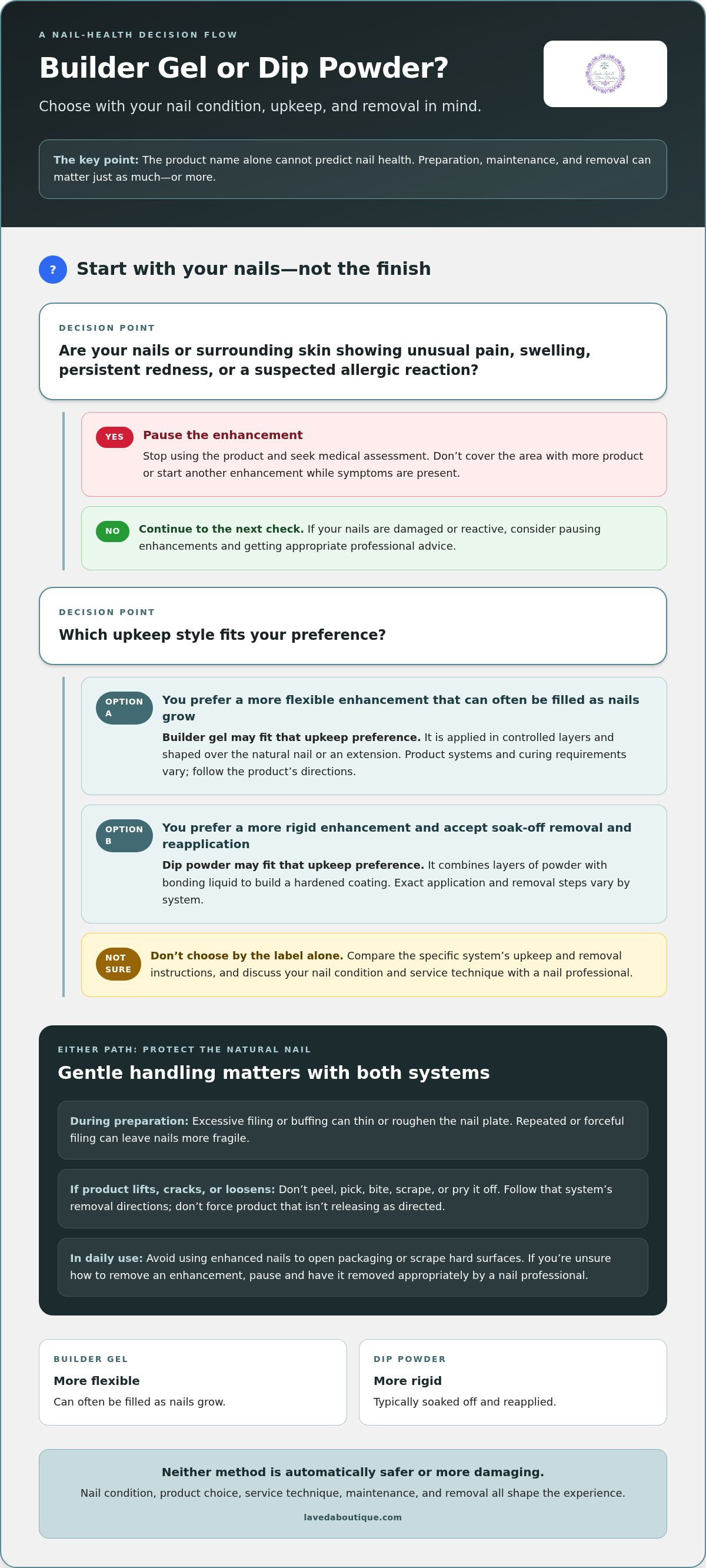
Start with your nails, not a trend or a promise of a “healthier” product. Consider your current nail condition, the finish you want, the upkeep you can manage, and how each system is removed. If your nails are damaged or you’ve had a reaction to nail products, pause before choosing either enhancement.
A simple checklist for matching a service to your priorities
Work through these points before booking. They can help you identify what matters most and what needs attention first.
Assess your nails now. Notice whether they’re painful, visibly damaged, unusually weak, or showing changes after a recent service. Recall any past sensitivity or reaction to nail products. If symptoms are present, address those concerns before adding another enhancement.
Decide on your preferred finish. Builder gel can be shaped into a structured overlay or extension, while dip powder builds coverage through layers of product. Think about the look and feel you prefer, but separate appearance from assumptions about nail health.
Match upkeep to your routine. Decide whether a service that may be maintained with fills suits you, or whether you’re comfortable with a system that typically involves soaking off and reapplying. Requirements vary by product and technique.
Consider removal before application. Understand the intended removal method for the specific system and whether you’re prepared to follow it. Discuss how the enhancement will be applied and removed before committing, and avoid any plan that relies on peeling, picking, or force.
This sequence keeps the decision practical. If flexibility in follow-up appointments matters, include it in your choice. If you’ve had a previous product reaction, don’t assume another enhancement system will automatically suit you. The question “is builder gel better than dip powder for nail health” has no answer that applies to everyone; both your nail condition and the service process matter.
When should you take a break from enhancements?
Pause enhancements if your nails are painful, visibly damaged, or reacting to a product. Don’t cover concerning changes with another layer or attempt forceful removal at home. There’s no single break duration that suits every nail, so don’t rely on an arbitrary timeline to decide when to resume.
If symptoms persist or you suspect an allergy, seek assessment from a medical professional. A nail service can’t diagnose the cause of a reaction or nail change. If you’re uncertain about proceeding, choose basic care without enhancements until you’ve received appropriate advice.
Nail care can still include a polished, comfortable service without an enhancement. For a professional manicure or pedicure in Washington, D.C., or Arlington, Virginia, explore professional manicure and pedicure services at Laveda.
Professional Nail Care in Washington, D.C. and Arlington, VA
There’s no universal winner in the builder gel versus dip powder comparison. Your nail condition, product system, service technique, and removal choices all shape the experience. A careful appointment can help you make informed choices, but no service can guarantee that nails will remain damage-free or that a product won’t cause sensitivity.
What to expect from a considered manicure appointment
Share your priorities at your appointment. Mention if your nails feel weak or uncomfortable, describe any recent product sensitivity, and explain the finish and upkeep you prefer. Discussing these details can clarify which service approach fits your goals and what maintenance or removal may involve. If your nails are damaged or you’re experiencing symptoms, pause enhancements and seek appropriate advice rather than treating a manicure as a solution.
A Russian manicure technique is distinct from builder gel and dip powder, not another name for either enhancement system. Keep that distinction clear when comparing manicure approaches, and focus on the service being considered.
Discussing the planned application and removal process before committing can help set clear expectations. You can talk through how the nail will be prepared, what the product system requires, and how removal should be handled. Follow product-specific instructions, and don’t agree to peeling or forceful removal. If a reaction or persistent symptom is involved, seek medical guidance; a nail appointment isn’t a substitute for assessment.
The question “is builder gel better than dip powder for nail health” is best considered in context. A professional conversation can help you weigh your preferences and nail-care priorities, but it can’t promise a particular health outcome. If enhancements don’t feel right for your nails, a manicure or pedicure without that added step may be a more comfortable choice.
Take the next step with local nail care
Laveda Lash & Brow Boutique offers manicure and pedicure services in Washington, D.C., and Arlington, Virginia. Share your preferences and nail-care concerns so your service choices reflect what matters to you. Thoughtful care starts with clear expectations and appropriate attention to your nails.
For local nail care, explore manicure and pedicure services at Laveda.
Make Your Next Nail-Care Choice With Confidence
Let your next manicure be guided by what your nails need now, not by pressure to choose one enhancement as universally healthier. If you’re still asking, “is builder gel better than dip powder for nail health,” focus on the details that matter to you: your nail condition, service preferences, and comfort with the upkeep.
Laveda is an independent Washington-area beauty boutique founded in 2018, and reports serving more than 20,000 satisfied customers. Its manicure and pedicure services offer a local option for your next step in nail care.
Choose a service that fits your preferences, and give yourself permission to pause enhancements if your nails need attention. Explore manicure and pedicure services at Laveda in Washington, D.C., and Arlington, Virginia.
Frequently Asked Questions
Is builder gel safer for natural nails than dip powder?
Neither builder gel nor dip powder is automatically safer for every natural nail. To assess whether is builder gel better than dip powder for nail health, consider your nail condition, the specific product system, and the planned application and removal. Don’t use an enhancement to conceal a split or tender nail. Pause if irritation or damage appears, and seek qualified advice for symptoms that persist.
Can dip powder damage your natural nails?
Yes, dip powder can contribute to nail damage if preparation is too aggressive or the product is picked, peeled, or removed by force. For example, prying up a lifted edge may pull at the natural nail beneath it. Damage isn’t inevitable, though. Careful technique and following the system’s instructions can help limit avoidable stress. Individual nail condition and sensitivity still vary.
Does builder gel make nails stronger or healthier?
Builder gel may make nails feel more supported while the enhancement is on, but that doesn’t mean the natural nail has become healthier. It’s a cosmetic service that can add structure, not a treatment for an underlying nail condition. Nor does it guarantee stronger nails after removal. If you notice ongoing changes, discomfort, or fragility, seek medical advice rather than relying on another layer of product.
Can I switch from builder gel to dip powder without a break?
It depends on your nail condition and how the builder gel is removed, so there’s no single answer for everyone. A switch should never involve peeling or forceful removal to get to the next service. If your nails feel tender, look visibly damaged, or are irritated, pause enhancements. Get appropriate professional guidance about nail care, and seek medical advice for persistent symptoms before applying another product.
Is an allergy to gel or dip nail products possible?
Yes, a reaction to nail products is possible, but an article can’t identify its cause. Itching, a rash, swelling, or persistent irritation after a service warrants stopping exposure and seeking medical advice. Don’t assume every reaction comes from the same ingredient, or that switching between gel and dip will prevent another one. Avoid applying more product to affected skin or nails until you’ve received appropriate guidance.
Should I give my natural nails a break between enhancements?
A break may be sensible if your nails feel sore, look damaged, or have become irritated, but there’s no universal schedule that fits everyone. Keep care gentle while you pause, and avoid picking at product or aggressively filing the nail surface. For ongoing changes, seek medical advice instead of treating time without enhancements as a substitute for assessment. In Washington, D.C., and Arlington, Virginia, Laveda also offers manicures and pedicures as local beauty-care options.
What should I do if my nails hurt after an enhancement?
Don’t pick, pry, or try to force the enhancement off. Persistent pain, swelling, redness, or other concerning symptoms should be assessed by a qualified medical professional. Discomfort can have different causes, and an online comparison can’t determine what’s behind yours or provide a diagnosis. Note when the pain began and whether it’s changing, then share that information with the clinician assessing your symptoms.


Players who enjoy unusual combat mechanics can explore Ragdoll Hit and see how its physics influence movement throughout each encounter.